
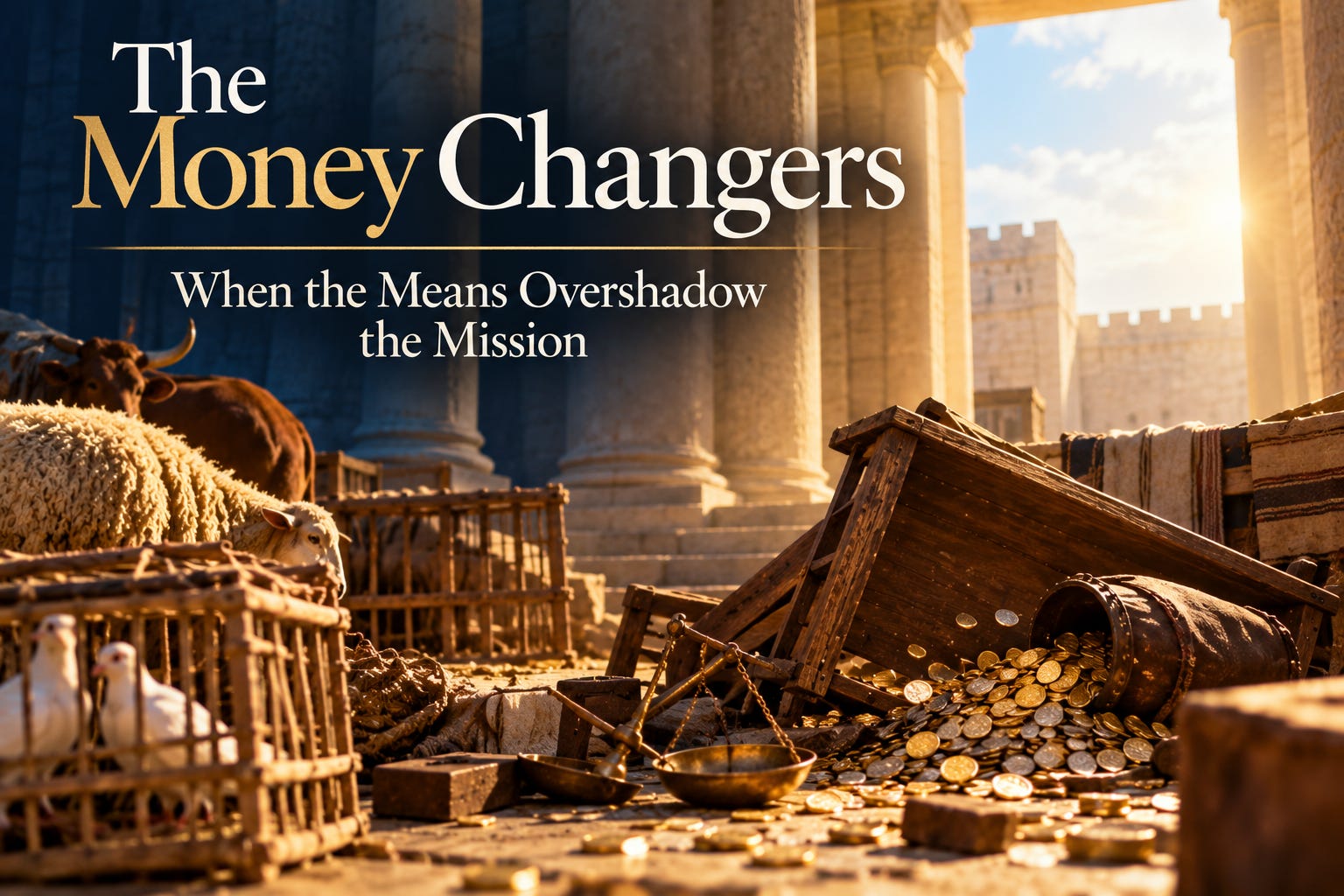
The Money Changers
In John 2, Jesus travels to Jerusalem because the Passover is approaching. Passover commemorated God’s deliverance of Israel from Egypt and was one of three major Jewish festivals, drawing worshippers to Jerusalem from many regions.
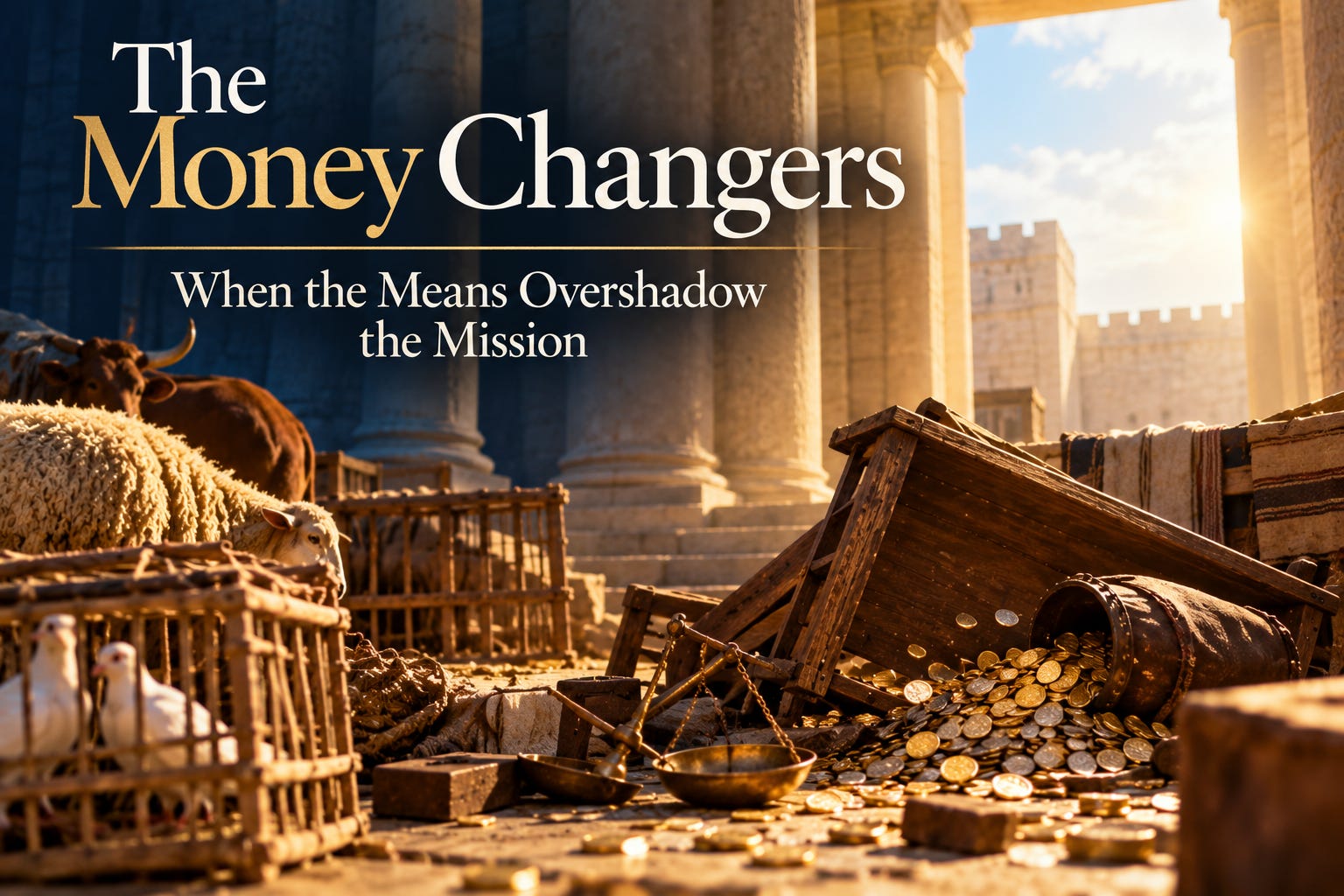
When Jesus entered the temple, He found merchants selling oxen, sheep, and doves, along with money changers conducting business. John records that Jesus made a scourge of small cords, drove them out of the temple, poured out the money changers’ money, and overturned their tables.
He then stated, “Take these things hence; make not my Father’s house an house of merchandise” (John 2:16).
Why was Jesus so upset about what was taking place?
We first need to understand what was happening. During Passover, Jews traveled to Jerusalem from many regions. They needed animals for sacrifices and appropriate currency for the temple tax. The merchants and money changers provided services that met legitimate needs, especially for those who had traveled long distances.
The issue was not necessarily that every transaction was illegitimate. The problem was where the business was being conducted and what it was doing to the character and purpose of the temple.
They had turned a place of worship into a marketplace.
The temple was intended to be a place where people approached God through prayer, sacrifice, and worship. Instead, commercial activity had consumed large sections of the temple.
Notice the words Jesus used: “My Father’s house.”
Jesus issue was not just the inappropriate business practices as many teach. He was defending the purpose of His Father’s house.
Mark’s account gives us an another view. Jesus declares, “Is it not written, My house shall be called of all nations the house of prayer? but ye have made it a den of thieves” (Mark 11:17).
Jesus was referring to Isaiah 56:7 and Jeremiah 7:11. God’s house was intended to be a house of prayer for all nations. Isaiah’s prophecy specifically identified foreigners who joined themselves to the Lord. But commercial activity had become part of the temple environment, potentially interfering with the very place where people came to worship.
But there is an even bigger issue that deserves our attention, because it is so prevalent today.
Religious activity had become disconnected from its purpose.
The animals were necessary for sacrifices. The money changers performed a practical service. But something intended to support worship had become the focus of Jesus’ anger.
Something can begin as a means of facilitating worship and eventually become a distraction from worship.
Do we see this happening in the church today?
Are our activities focused on the primary purposes of our fellowship? Have we turned worship services into concerts and performances? Have we become more concerned with the programs we conduct than the people those programs are intended to serve?
There is nothing wrong with programs, organized activities, or excellence in worship. But we must continually examine whether these things are helping us fulfill God’s purpose or distracting us from it.
It is possible to become so occupied with the activities of the church that we lose sight of the purpose of the church.
We can become more concerned with maintaining buildings, conducting services, and sustaining programs than with developing disciples, building relationships, and caring for one another.
What began as a way of facilitating the work of God can gradually become an end in itself.
John records that when the disciples witnessed Jesus cleansing the temple, they remembered that it was written, “The zeal of thine house hath eaten me up” (John 2:17).
This quotation comes from Psalm 69:9, a psalm attributed to David.
The word zeal conveys intense passion, fervor, or ardent devotion. The expression “hath eaten me up” communicates something that consumes a person’s attention, energy, and life.
Jesus was not acting out of uncontrolled temper. His actions expressed His commitment to the holiness and purpose of His Father’s house.
The honor of His Father was not a small thing to our Lord. It was central to His entire mission.
But there is more beneath the surface of Psalm 69.
David speaks of the suffering and reproach he experienced because of his devotion to God. In verse 7 he writes, “Because for thy sake I have borne reproach; shame hath covered my face.”
Then in verse 9 he declares, “For the zeal of thine house hath eaten me up; and the reproaches of them that reproached thee are fallen upon me.”
David’s devotion to God resulted in opposition and personal suffering.
When John’s disciples remembered this passage, they were recognizing something that was very critical about Jesus. His zeal for His Father’s house would not only produce admiration. It would provoke opposition, and that opposition would contribute to His suffering and death.
Notice what happens immediately after Jesus cleanses the temple.
The religious authorities demand a sign proving His authority to do these things. Jesus responds, “Destroy this temple, and in three days I will raise it up” (John 2:19).
John explains that Jesus was speaking of the temple of His body.
Jesus defends His Father’s house. The disciples remember Psalm 69. The religious authorities challenge His authority. And Jesus points toward His death and resurrection.
John is doing more than telling us that Jesus was upset about merchants. He is revealing the One who was consumed with His Father’s purpose, and whose commitment to that purpose would lead Him to the cross.
The zeal that drove Jesus to cleanse the temple was part of the same devotion that carried Him toward Calvary.
There is also an important connection between the wedding at Cana and the cleansing of the temple.
At Cana, Jesus transformed water into wine. The water was associated with ceremonial washing and outward purification. The wine, however, was intended to be consumed and received internally.
The stone vessels held water for outward purification, but Jesus transformed that water into something that would become part of the person who received it.
The vessels themselves did not produce the transformation. Jesus did.
This provides a powerful illustration of the difference between outward religious observance and the inward transformation Christ brings.
Jesus later confronted this very distinction in Matthew 23:25–26, when He rebuked the scribes and Pharisees for cleaning the outside of the cup while the inside remained full of corruption.
His instruction was to cleanse first that which was within.
True transformation must reach the inner person. Religious observance can affect outward conduct, but only God can transform the heart.
Jeremiah 31:33 speaks of God’s law being written upon the heart. Ezekiel 36:26–27 promises a new heart and God’s Spirit within His people.
Under the new covenant, God’s work is not limited to external commandments and observances. His Spirit works within us.
At Cana, Jesus demonstrated His power to transform. At the temple, He demonstrated His zeal for the holiness and purpose of His Father’s house.
And now, through the indwelling of the Holy Spirit, we are God’s temple, both individually and collectively as the Body of Christ.
Paul reminds us in 1 Corinthians 3:16–17 that the Church collectively is God’s temple. In 1 Corinthians 6:19–20, he teaches that our individual bodies are temples of the Holy Ghost and that we must glorify God in them.
This raises an important question.
If Jesus was zealous about protecting the holiness of the physical temple, should we be any less zealous about protecting the temple in which His Spirit now dwells?
We must guard our hearts and minds, being careful about what we allow to influence our thinking, shape our desires, and direct our decisions.
Proverbs 4:23 states, “Keep thy heart with all diligence; for out of it are the issues of life.”
Romans 12:2 reminds us not to be conformed to this world, but to be transformed by the renewing of our minds.
Our responsibility has two dimensions:
Individually, we must be diligent about what we allow into our hearts and minds, what influences our thinking, what shapes our desires, and how we treat our bodies.
Collectively, we must protect the Body of Christ from division, corruption, false teaching, bitterness, and anything that compromises its holiness and unity.
Yet there is an important distinction. We do not keep ourselves holy through human effort alone. The Holy Spirit transforms us, and we cooperate with His work through obedience, discernment, and discipline.
The lesson is that inward transformation must be accompanied by vigilant stewardship.
We cannot invite Christ to transform our hearts while carelessly allowing the very things that corrupt them to remain.
We cannot claim to be the Body of Christ while tolerating the things that destroy its unity and compromise its witness.
Jesus cleansed the temple because it belonged to His Father.
We must zealously guard our hearts, renew our minds, honor our bodies, and protect the fellowship of believers because we belong to Him.
Remember three important truths from Paul’s teaching: Your body is a temple. You are not your own. You were bought with a price.
Stewardship is our response to redemption.
The money changers provided services that had a legitimate purpose, but the place as well as how those services were being conducted had become a problem.
This should cause us to examine our own religious activities with the same seriousness.
Have we allowed the things intended to facilitate worship to become distractions from worship? Have our programs, traditions, and practices become more important than the purposes they were intended to serve?
And beyond our collective worship, what about our individual lives?
Jesus confronted what did not belong in His Father’s house. Are we willing to confront what does not belong in ours?
His zeal was rooted in devotion to His Father. Our discipline should flow from that same love and reverence for God.
We cannot claim to honor the presence of God while remaining indifferent to how we treat the place where His Spirit dwells.
If Jesus walked into the temple of our hearts today, what would He find that does not belong there?
Thank you for reading. If this has blessed you consider supporting my work. I have a book coming out on November 16. Click the link below to preorder.