
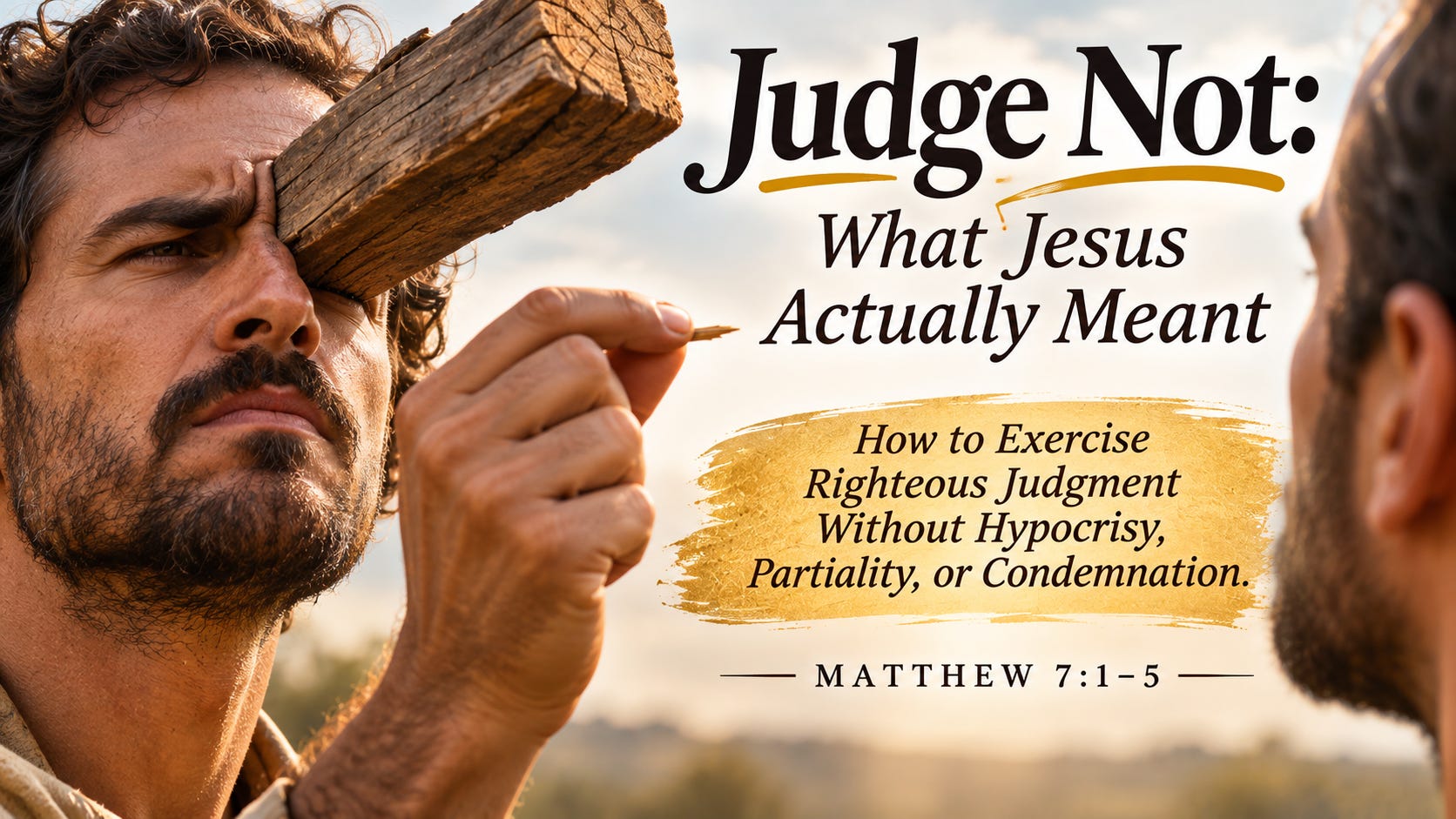
Judge Not: What Jesus Actually Meant
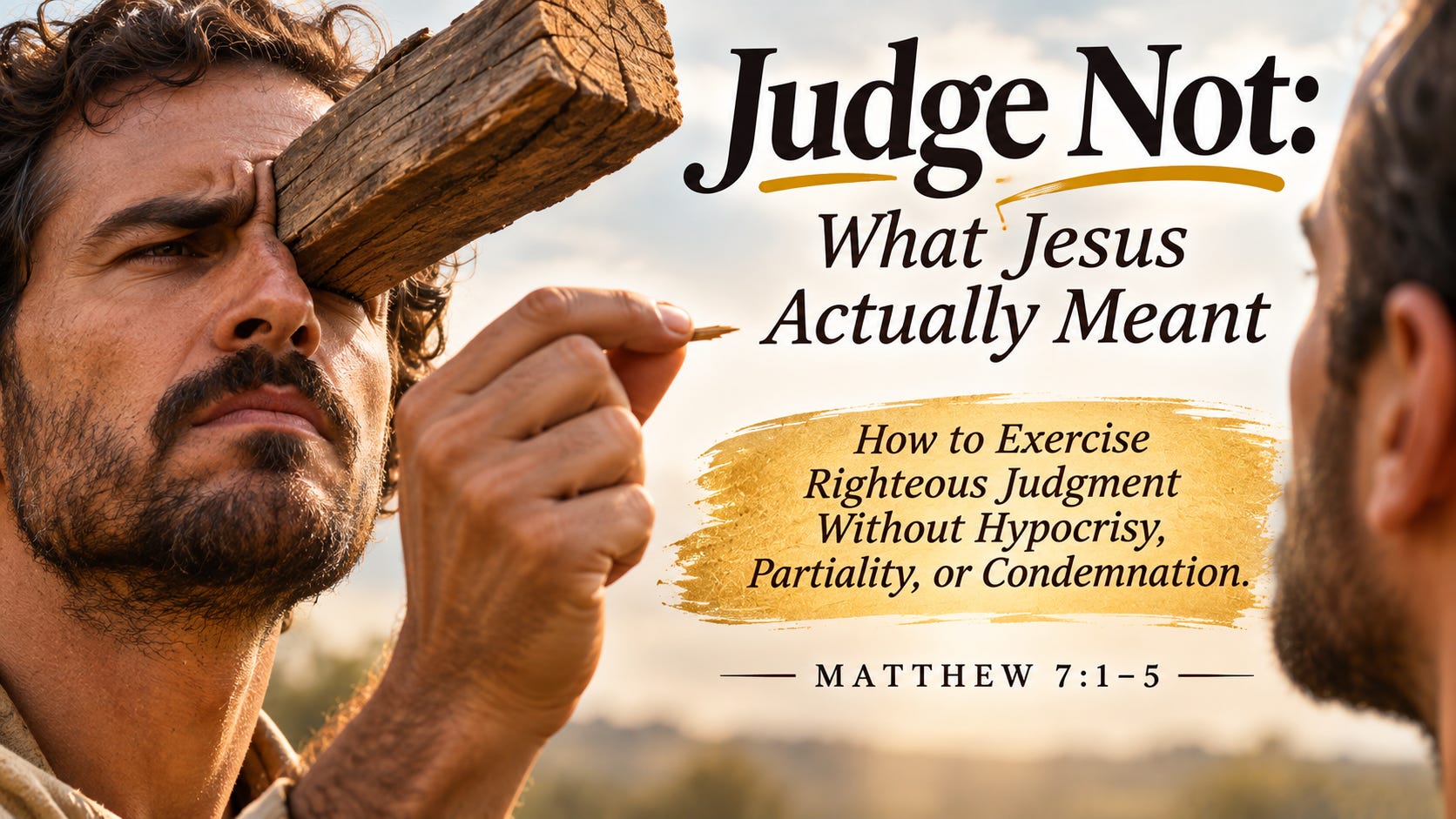
There are many passages in the Bible which are often used as absolute statements often without full context. The statement by Jesus in Matthew 7:1 “Judge not that ye be not judged is one of the more misappropriated and misunderstood of these scriptures. Today I want us to go beneath the ink to understand what Jesus is actually saying because when we understand his command, we allow ourselves to operate in honesty and integrity as the body of Christ.
Matthew 7:1–5 (KJV)
(1) Judge not, that ye be not judged. (2) For with what judgment ye judge, ye shall be judged: and with what measure ye mete, it shall be measured to you again. (3) And why beholdest thou the mote that is in thy brother’s eye, but considerest not the beam that is in thine own eye? (4) Or how wilt thou say to thy brother, Let me pull out the mote out of thine eye; and, behold, a beam is in thine own eye? (5) Thou hypocrite, first cast out the beam out of thine own eye; and then shalt thou see clearly to cast out the mote out of thy brother’s eye.
We cannot avoid judging. This is a critical aspect of how our mind works, appraisals are inevitable. If we were witnesses to a flagrant violation of the law in which innocent people were harmed, could we keep quiet because we are not to judge?
Does not Jesus require us to never exercise judgment in verse 6?
“Give not that which is holy unto the dogs, neither cast ye your pearls before swine, lest they trample them under their feet, and turn again and rend you.”
Do we not have to exercise discernment to determine who Jesus is describing as “dogs” or “swine”?
Considering verse 15:
“Beware of false prophets, which come to you in sheep’s clothing, but inwardly they are ravening wolves.”
Do we not have to judge whether a man is a false minister? Do we not have to reject his teaching based on an appraisal of his fruits?
Jesus later tells us in John 7:24:
“Judge not according to the appearance, but judge righteous judgment.”
We must make sure that we understand clearly what Jesus meant so that we may apply the scripture correctly. He obviously did not mean we should not judge at all.
Within the context of Luke 6:35–38, Jesus uses “Judge not, and ye shall not be judged” to urge us to love our enemies, be merciful, forgiving, and generous.
This adds some critical context to Matthew’s account, showing that “Judge not” is a warning against self-righteous severity, sharp-tongued criticism, and condemnation.
Thus, it is not a command to be absolutely neutral and tolerant regarding moral issues, but a warning to be careful, fair, and loving when we judge.
There are at least three principles we must consider.
1. Before Judging Others, We Must First Judge Ourselves
Jesus asks why we behold the mote in our brother’s eye while failing to consider the beam in our own.
Notice that Jesus does not say the mote in our brother’s eye is imaginary. There may indeed be something that needs to be addressed.
The problem is that we are so focused on the fault of another that we fail to recognize our own, sometimes greater, fault.
Jesus calls this hypocrisy.
He does not instruct us to ignore the mote. He tells us to remove the beam from our own eye first, so that we can see clearly enough to help our brother.
Paul makes a similar point in Romans 2:1:
“Therefore thou art inexcusable, O man, whosoever thou art that judgest: for wherein thou judgest another, thou condemnest thyself; for thou that judgest doest the same things.”
Before we confront someone else’s conduct, we should ask ourselves whether we are guilty of the same behavior.
Are we condemning in another what we excuse in ourselves?
Are we holding others to standards we are unwilling to live by?
We are quick to excuse our own shortcomings while legislating the shortcomings of others.
We offer explanations for our failures but demand accountability for theirs. We ask others to understand our circumstances while refusing to extend the same consideration to them.
And are we approaching our brother out of genuine concern for his spiritual well-being, or because pointing out his faults makes us feel better about ourselves?
Galatians 6:1 reminds us that even when someone is overtaken in a fault, those who are spiritual should restore that person in a spirit of meekness, considering themselves lest they also be tempted.
The purpose of correction should be restoration, not humiliation.
2. We Must Judge Without Partiality
Another danger is allowing our personal relationships, preferences, or someone’s position to influence our judgment.
We may be quick to criticize someone we dislike while overlooking the same behavior in someone we admire.
We may confront someone with little influence while remaining silent when the same conduct is displayed by someone of greater status, wealth, or authority.
But righteous judgment cannot be based on who someone is or how we feel about them.
James 2:1 warns:
“My brethren, have not the faith of our Lord Jesus Christ, the Lord of glory, with respect of persons.”
And Leviticus 19:15 declares:
“Ye shall do no unrighteousness in judgment: thou shalt not respect the person of the poor, nor honour the person of the mighty: but in righteousness shalt thou judge thy neighbour.”
God’s standard of righteousness does not change according to someone’s popularity, position, or relationship to us.
If something is wrong when committed by someone we dislike, it does not suddenly become acceptable when committed by someone we love or admire.
This is especially important within the Church.
We must not allow titles, positions, financial influence, or personal relationships to determine whose conduct we are willing to address.
Partiality corrupts judgment because it substitutes personal preference for righteousness.
3. We Are All Servants, Not Masters
There are practical reasons why Jesus would advise us to be careful when judging others.
The most critical point to remember is that even though it is necessary that we judge rightly, it is even more important that we do not usurp the place of God!
Romans 14:4 asks:
“Who art thou that judgest another man’s servant? to his own master he standeth or falleth. Yea, he shall be holden up: for God is able to make him stand.”
Paul begins his letter to the Romans by calling himself a servant of Jesus Christ. Later, in Romans 14:7–8, he reminds us that whether we live or die, we belong to the Lord.
A servant does not have the same rights and responsibilities as a master.
Though we are permitted, and at times required, to make an appraisal of conduct, we are not permitted to assume God’s authority to pronounce final condemnation upon a fellow servant.
A fellow servant does not ultimately stand or fall at the bar of our judgment.
The final judgment belongs to our mutual Master.
James 4:12 reminds us:
“There is one lawgiver, who is able to save and to destroy: who art thou that judgest another?”
This does not mean that conduct is beyond examination or that the Church has no responsibility to address sin. Scripture clearly teaches otherwise.
But there is a difference between recognizing that someone’s conduct is wrong and assuming the authority to determine that person’s ultimate standing before God.
We may judge an action without presuming to know everything about the person who committed it.
We may confront sin without condemning the sinner.
We may call someone to repentance while remembering that we, too, are servants who must answer to the same Master.
To assume God’s ultimate authority is an act of presumption.
Correction Is Not Condemnation
This in no way means we cannot approach a brother to inquire about and understand his conduct so that we might know whether our appraisal is correct.
Assuming that our intent in questioning him is for his good, why would we even approach him?
Would it not be because our evaluation of his conduct had led us to conclude, yes, to judge, that he was in serious moral or spiritual trouble?
Jesus gives us instructions for addressing a brother who sins in Matthew 18:15–17.
The objective begins with gaining our brother, not destroying him.
There is a world of difference between approaching someone because we want to see them restored and approaching them because we want to see them condemned.
One is motivated by love. The other may be motivated by pride, resentment, or self-righteousness.
And we must be careful not to confuse the two.
Before We Judge
The next time we find ourselves evaluating another person’s conduct, perhaps we should begin with three questions:
1. Have I examined myself? Am I guilty of the same thing, and am I approaching this person with humility?
2. Am I being impartial? Would I apply the same standard if this were someone I loved, admired, or depended upon?
3. Am I acting as a fellow servant or assuming the position of the Master? Is my desire to help restore this person, or have I already condemned them?
Jesus did not tell us to abandon discernment. He told us to exercise righteous judgment.
And righteous judgment requires more than recognizing what is wrong in someone else.
It requires humility, impartiality, mercy, and an awareness of our own accountability before God.
We are called to discern what is right, confront what is wrong, and seek the restoration of those who have fallen. But we must never forget that we are all servants, and none of us is the Master.
Thank you for reading. If this has blessed you consider supporting my work. I have a book coming out on November 16. Click the link below to preorder.
Learn MoreJudge Not: What Jesus Actually Meant
There are many passages in the Bible which are often used as absolute statements often without full context. The statement by Jesus in Matthew 7:1 “Judge not that ye be not judged is one of the more misappropriated and misunderstood of these scriptures. Today I want us to go beneath the ink to understand what Jesus is actually saying because when we understand his command, we allow ourselves to operate in honesty and integrity as the body of Christ.
Matthew 7:1–5 (KJV)
(1) Judge not, that ye be not judged. (2) For with what judgment ye judge, ye shall be judged: and with what measure ye mete, it shall be measured to you again. (3) And why beholdest thou the mote that is in thy brother’s eye, but considerest not the beam that is in thine own eye? (4) Or how wilt thou say to thy brother, Let me pull out the mote out of thine eye; and, behold, a beam is in thine own eye? (5) Thou hypocrite, first cast out the beam out of thine own eye; and then shalt thou see clearly to cast out the mote out of thy brother’s eye.
We cannot avoid judging. This is a critical aspect of how our mind works, appraisals are inevitable. If we were witnesses to a flagrant violation of the law in which innocent people were harmed, could we keep quiet because we are not to judge?
Does not Jesus require us to never exercise judgment in verse 6?
“Give not that which is holy unto the dogs, neither cast ye your pearls before swine, lest they trample them under their feet, and turn again and rend you.”
Do we not have to exercise discernment to determine who Jesus is describing as “dogs” or “swine”?
Considering verse 15:
“Beware of false prophets, which come to you in sheep’s clothing, but inwardly they are ravening wolves.”
Do we not have to judge whether a man is a false minister? Do we not have to reject his teaching based on an appraisal of his fruits?
Jesus later tells us in John 7:24:
“Judge not according to the appearance, but judge righteous judgment.”
We must make sure that we understand clearly what Jesus meant so that we may apply the scripture correctly. He obviously did not mean we should not judge at all.
Within the context of Luke 6:35–38, Jesus uses “Judge not, and ye shall not be judged” to urge us to love our enemies, be merciful, forgiving, and generous.
This adds some critical context to Matthew’s account, showing that “Judge not” is a warning against self-righteous severity, sharp-tongued criticism, and condemnation.
Thus, it is not a command to be absolutely neutral and tolerant regarding moral issues, but a warning to be careful, fair, and loving when we judge.
There are at least three principles we must consider.
1. Before Judging Others, We Must First Judge Ourselves
Jesus asks why we behold the mote in our brother’s eye while failing to consider the beam in our own.
Notice that Jesus does not say the mote in our brother’s eye is imaginary. There may indeed be something that needs to be addressed.
The problem is that we are so focused on the fault of another that we fail to recognize our own, sometimes greater, fault.
Jesus calls this hypocrisy.
He does not instruct us to ignore the mote. He tells us to remove the beam from our own eye first, so that we can see clearly enough to help our brother.
Paul makes a similar point in Romans 2:1:
“Therefore thou art inexcusable, O man, whosoever thou art that judgest: for wherein thou judgest another, thou condemnest thyself; for thou that judgest doest the same things.”
Before we confront someone else’s conduct, we should ask ourselves whether we are guilty of the same behavior.
Are we condemning in another what we excuse in ourselves?
Are we holding others to standards we are unwilling to live by?
We are quick to excuse our own shortcomings while legislating the shortcomings of others.
We offer explanations for our failures but demand accountability for theirs. We ask others to understand our circumstances while refusing to extend the same consideration to them.
And are we approaching our brother out of genuine concern for his spiritual well-being, or because pointing out his faults makes us feel better about ourselves?
Galatians 6:1 reminds us that even when someone is overtaken in a fault, those who are spiritual should restore that person in a spirit of meekness, considering themselves lest they also be tempted.
The purpose of correction should be restoration, not humiliation.
2. We Must Judge Without Partiality
Another danger is allowing our personal relationships, preferences, or someone’s position to influence our judgment.
We may be quick to criticize someone we dislike while overlooking the same behavior in someone we admire.
We may confront someone with little influence while remaining silent when the same conduct is displayed by someone of greater status, wealth, or authority.
But righteous judgment cannot be based on who someone is or how we feel about them.
James 2:1 warns:
“My brethren, have not the faith of our Lord Jesus Christ, the Lord of glory, with respect of persons.”
And Leviticus 19:15 declares:
“Ye shall do no unrighteousness in judgment: thou shalt not respect the person of the poor, nor honour the person of the mighty: but in righteousness shalt thou judge thy neighbour.”
God’s standard of righteousness does not change according to someone’s popularity, position, or relationship to us.
If something is wrong when committed by someone we dislike, it does not suddenly become acceptable when committed by someone we love or admire.
This is especially important within the Church.
We must not allow titles, positions, financial influence, or personal relationships to determine whose conduct we are willing to address.
Partiality corrupts judgment because it substitutes personal preference for righteousness.
3. We Are All Servants, Not Masters
There are practical reasons why Jesus would advise us to be careful when judging others.
The most critical point to remember is that even though it is necessary that we judge rightly, it is even more important that we do not usurp the place of God!
Romans 14:4 asks:
“Who art thou that judgest another man’s servant? to his own master he standeth or falleth. Yea, he shall be holden up: for God is able to make him stand.”
Paul begins his letter to the Romans by calling himself a servant of Jesus Christ. Later, in Romans 14:7–8, he reminds us that whether we live or die, we belong to the Lord.
A servant does not have the same rights and responsibilities as a master.
Though we are permitted, and at times required, to make an appraisal of conduct, we are not permitted to assume God’s authority to pronounce final condemnation upon a fellow servant.
A fellow servant does not ultimately stand or fall at the bar of our judgment.
The final judgment belongs to our mutual Master.
James 4:12 reminds us:
“There is one lawgiver, who is able to save and to destroy: who art thou that judgest another?”
This does not mean that conduct is beyond examination or that the Church has no responsibility to address sin. Scripture clearly teaches otherwise.
But there is a difference between recognizing that someone’s conduct is wrong and assuming the authority to determine that person’s ultimate standing before God.
We may judge an action without presuming to know everything about the person who committed it.
We may confront sin without condemning the sinner.
We may call someone to repentance while remembering that we, too, are servants who must answer to the same Master.
To assume God’s ultimate authority is an act of presumption.
Correction Is Not Condemnation
This in no way means we cannot approach a brother to inquire about and understand his conduct so that we might know whether our appraisal is correct.
Assuming that our intent in questioning him is for his good, why would we even approach him?
Would it not be because our evaluation of his conduct had led us to conclude, yes, to judge, that he was in serious moral or spiritual trouble?
Jesus gives us instructions for addressing a brother who sins in Matthew 18:15–17.
The objective begins with gaining our brother, not destroying him.
There is a world of difference between approaching someone because we want to see them restored and approaching them because we want to see them condemned.
One is motivated by love. The other may be motivated by pride, resentment, or self-righteousness.
And we must be careful not to confuse the two.
Before We Judge
The next time we find ourselves evaluating another person’s conduct, perhaps we should begin with three questions:
1. Have I examined myself? Am I guilty of the same thing, and am I approaching this person with humility?
2. Am I being impartial? Would I apply the same standard if this were someone I loved, admired, or depended upon?
3. Am I acting as a fellow servant or assuming the position of the Master? Is my desire to help restore this person, or have I already condemned them?
Jesus did not tell us to abandon discernment. He told us to exercise righteous judgment.
And righteous judgment requires more than recognizing what is wrong in someone else.
It requires humility, impartiality, mercy, and an awareness of our own accountability before God.
We are called to discern what is right, confront what is wrong, and seek the restoration of those who have fallen. But we must never forget that we are all servants, and none of us is the Master.
Thank you for reading. If this has blessed you consider supporting my work. I have a book coming out on November 16. Click the link below to preorder.
Learn More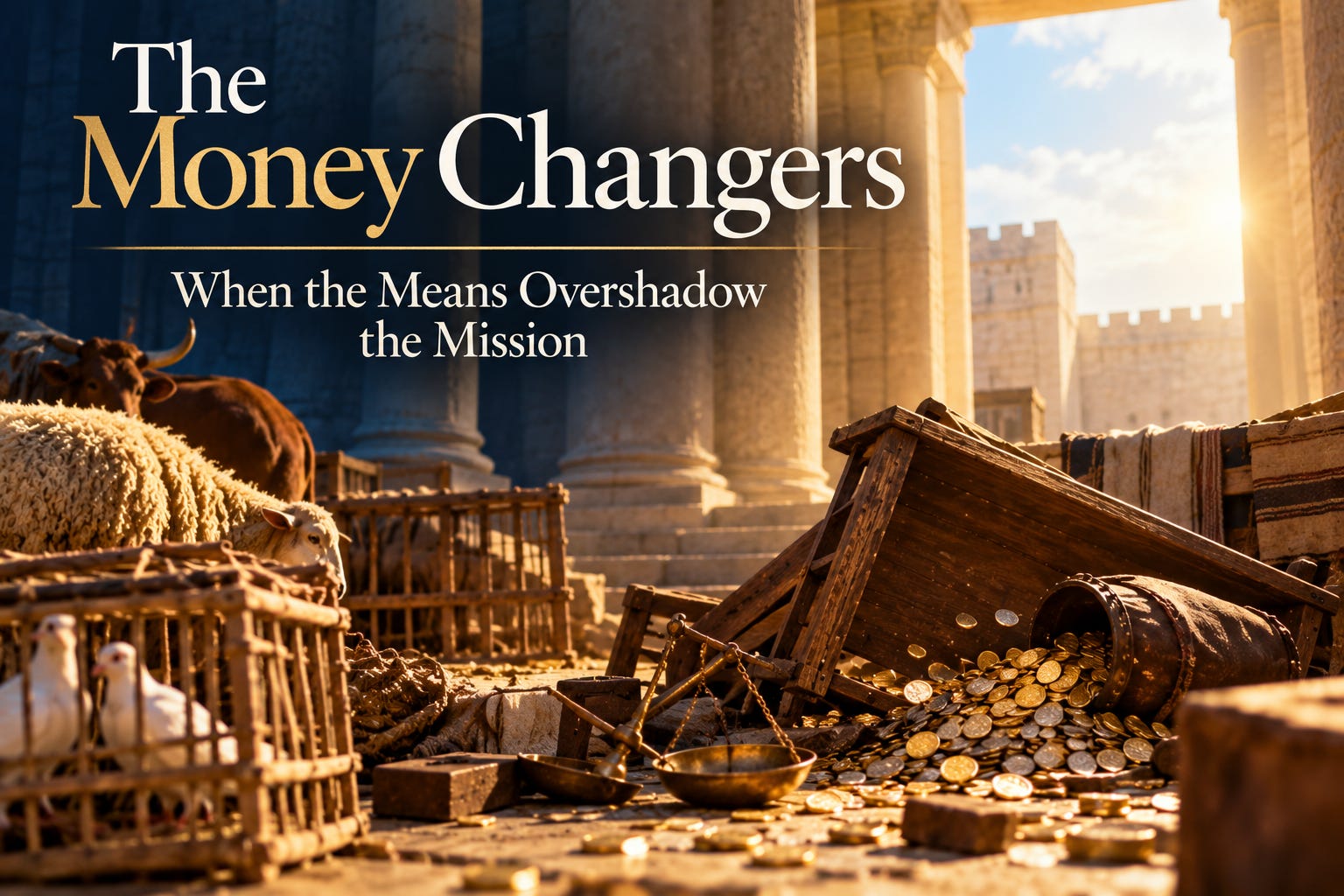
The Money Changers
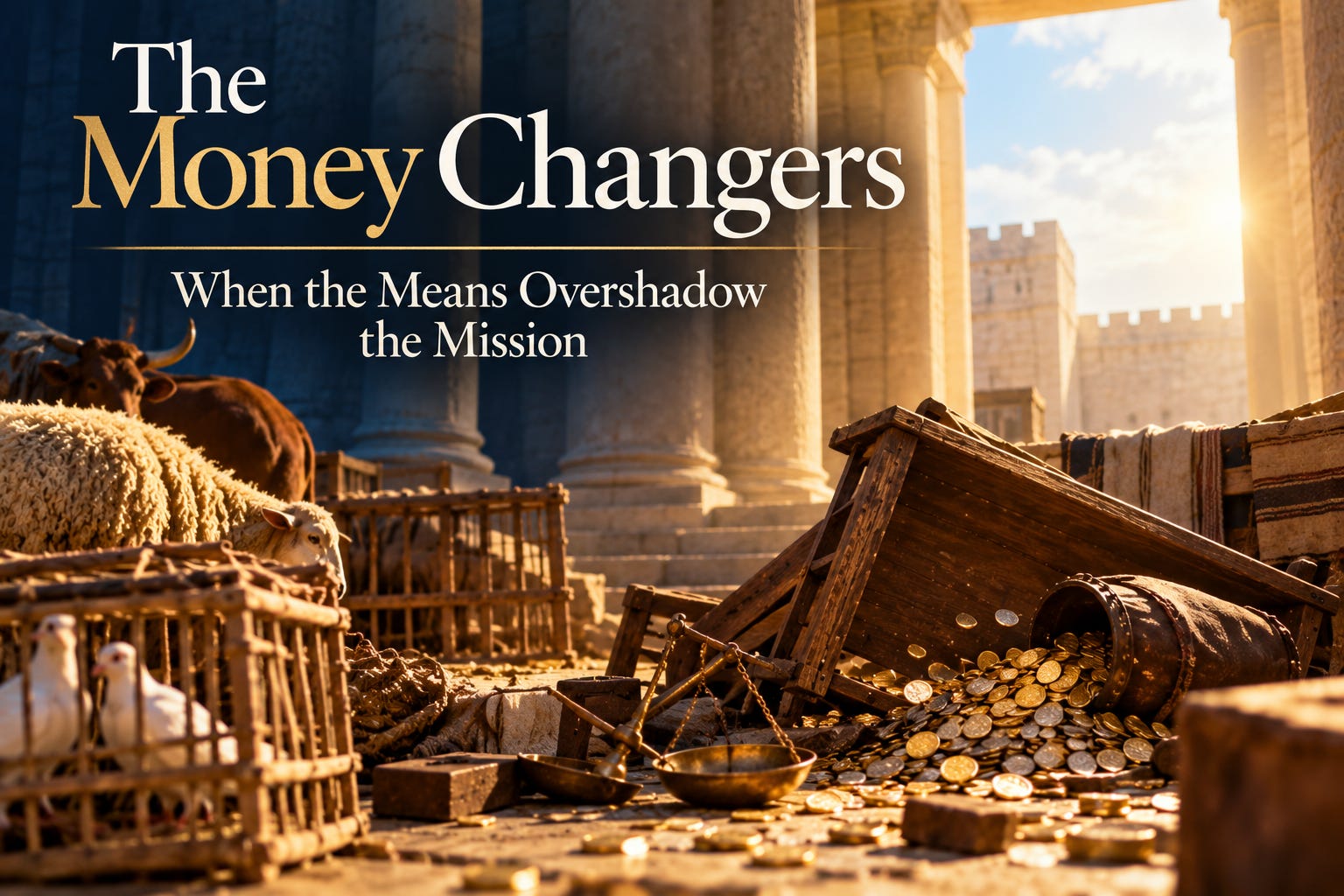
In John 2, Jesus travels to Jerusalem because the Passover is approaching. Passover commemorated God’s deliverance of Israel from Egypt and was one of three major Jewish festivals, drawing worshippers to Jerusalem from many regions.
When Jesus entered the temple, He found merchants selling oxen, sheep, and doves, along with money changers conducting business. John records that Jesus made a scourge of small cords, drove them out of the temple, poured out the money changers’ money, and overturned their tables.
He then stated, “Take these things hence; make not my Father’s house an house of merchandise” (John 2:16).
Why was Jesus so upset about what was taking place?
We first need to understand what was happening. During Passover, Jews traveled to Jerusalem from many regions. They needed animals for sacrifices and appropriate currency for the temple tax. The merchants and money changers provided services that met legitimate needs, especially for those who had traveled long distances.
The issue was not necessarily that every transaction was illegitimate. The problem was where the business was being conducted and what it was doing to the character and purpose of the temple.
They had turned a place of worship into a marketplace.
The temple was intended to be a place where people approached God through prayer, sacrifice, and worship. Instead, commercial activity had consumed large sections of the temple.
Notice the words Jesus used: “My Father’s house.”
Jesus issue was not just the inappropriate business practices as many teach. He was defending the purpose of His Father’s house.
Mark’s account gives us an another view. Jesus declares, “Is it not written, My house shall be called of all nations the house of prayer? but ye have made it a den of thieves” (Mark 11:17).
Jesus was referring to Isaiah 56:7 and Jeremiah 7:11. God’s house was intended to be a house of prayer for all nations. Isaiah’s prophecy specifically identified foreigners who joined themselves to the Lord. But commercial activity had become part of the temple environment, potentially interfering with the very place where people came to worship.
But there is an even bigger issue that deserves our attention, because it is so prevalent today.
Religious activity had become disconnected from its purpose.
The animals were necessary for sacrifices. The money changers performed a practical service. But something intended to support worship had become the focus of Jesus’ anger.
Something can begin as a means of facilitating worship and eventually become a distraction from worship.
Do we see this happening in the church today?
Are our activities focused on the primary purposes of our fellowship? Have we turned worship services into concerts and performances? Have we become more concerned with the programs we conduct than the people those programs are intended to serve?
There is nothing wrong with programs, organized activities, or excellence in worship. But we must continually examine whether these things are helping us fulfill God’s purpose or distracting us from it.
It is possible to become so occupied with the activities of the church that we lose sight of the purpose of the church.
We can become more concerned with maintaining buildings, conducting services, and sustaining programs than with developing disciples, building relationships, and caring for one another.
What began as a way of facilitating the work of God can gradually become an end in itself.
John records that when the disciples witnessed Jesus cleansing the temple, they remembered that it was written, “The zeal of thine house hath eaten me up” (John 2:17).
This quotation comes from Psalm 69:9, a psalm attributed to David.
The word zeal conveys intense passion, fervor, or ardent devotion. The expression “hath eaten me up” communicates something that consumes a person’s attention, energy, and life.
Jesus was not acting out of uncontrolled temper. His actions expressed His commitment to the holiness and purpose of His Father’s house.
The honor of His Father was not a small thing to our Lord. It was central to His entire mission.
But there is more beneath the surface of Psalm 69.
David speaks of the suffering and reproach he experienced because of his devotion to God. In verse 7 he writes, “Because for thy sake I have borne reproach; shame hath covered my face.”
Then in verse 9 he declares, “For the zeal of thine house hath eaten me up; and the reproaches of them that reproached thee are fallen upon me.”
David’s devotion to God resulted in opposition and personal suffering.
When John’s disciples remembered this passage, they were recognizing something that was very critical about Jesus. His zeal for His Father’s house would not only produce admiration. It would provoke opposition, and that opposition would contribute to His suffering and death.
Notice what happens immediately after Jesus cleanses the temple.
The religious authorities demand a sign proving His authority to do these things. Jesus responds, “Destroy this temple, and in three days I will raise it up” (John 2:19).
John explains that Jesus was speaking of the temple of His body.
Jesus defends His Father’s house. The disciples remember Psalm 69. The religious authorities challenge His authority. And Jesus points toward His death and resurrection.
John is doing more than telling us that Jesus was upset about merchants. He is revealing the One who was consumed with His Father’s purpose, and whose commitment to that purpose would lead Him to the cross.
The zeal that drove Jesus to cleanse the temple was part of the same devotion that carried Him toward Calvary.
There is also an important connection between the wedding at Cana and the cleansing of the temple.
At Cana, Jesus transformed water into wine. The water was associated with ceremonial washing and outward purification. The wine, however, was intended to be consumed and received internally.
The stone vessels held water for outward purification, but Jesus transformed that water into something that would become part of the person who received it.
The vessels themselves did not produce the transformation. Jesus did.
This provides a powerful illustration of the difference between outward religious observance and the inward transformation Christ brings.
Jesus later confronted this very distinction in Matthew 23:25–26, when He rebuked the scribes and Pharisees for cleaning the outside of the cup while the inside remained full of corruption.
His instruction was to cleanse first that which was within.
True transformation must reach the inner person. Religious observance can affect outward conduct, but only God can transform the heart.
Jeremiah 31:33 speaks of God’s law being written upon the heart. Ezekiel 36:26–27 promises a new heart and God’s Spirit within His people.
Under the new covenant, God’s work is not limited to external commandments and observances. His Spirit works within us.
At Cana, Jesus demonstrated His power to transform. At the temple, He demonstrated His zeal for the holiness and purpose of His Father’s house.
And now, through the indwelling of the Holy Spirit, we are God’s temple, both individually and collectively as the Body of Christ.
Paul reminds us in 1 Corinthians 3:16–17 that the Church collectively is God’s temple. In 1 Corinthians 6:19–20, he teaches that our individual bodies are temples of the Holy Ghost and that we must glorify God in them.
This raises an important question.
If Jesus was zealous about protecting the holiness of the physical temple, should we be any less zealous about protecting the temple in which His Spirit now dwells?
We must guard our hearts and minds, being careful about what we allow to influence our thinking, shape our desires, and direct our decisions.
Proverbs 4:23 states, “Keep thy heart with all diligence; for out of it are the issues of life.”
Romans 12:2 reminds us not to be conformed to this world, but to be transformed by the renewing of our minds.
Our responsibility has two dimensions:
Individually, we must be diligent about what we allow into our hearts and minds, what influences our thinking, what shapes our desires, and how we treat our bodies.
Collectively, we must protect the Body of Christ from division, corruption, false teaching, bitterness, and anything that compromises its holiness and unity.
Yet there is an important distinction. We do not keep ourselves holy through human effort alone. The Holy Spirit transforms us, and we cooperate with His work through obedience, discernment, and discipline.
The lesson is that inward transformation must be accompanied by vigilant stewardship.
We cannot invite Christ to transform our hearts while carelessly allowing the very things that corrupt them to remain.
We cannot claim to be the Body of Christ while tolerating the things that destroy its unity and compromise its witness.
Jesus cleansed the temple because it belonged to His Father.
We must zealously guard our hearts, renew our minds, honor our bodies, and protect the fellowship of believers because we belong to Him.
Remember three important truths from Paul’s teaching: Your body is a temple. You are not your own. You were bought with a price.
Stewardship is our response to redemption.
The money changers provided services that had a legitimate purpose, but the place as well as how those services were being conducted had become a problem.
This should cause us to examine our own religious activities with the same seriousness.
Have we allowed the things intended to facilitate worship to become distractions from worship? Have our programs, traditions, and practices become more important than the purposes they were intended to serve?
And beyond our collective worship, what about our individual lives?
Jesus confronted what did not belong in His Father’s house. Are we willing to confront what does not belong in ours?
His zeal was rooted in devotion to His Father. Our discipline should flow from that same love and reverence for God.
We cannot claim to honor the presence of God while remaining indifferent to how we treat the place where His Spirit dwells.
If Jesus walked into the temple of our hearts today, what would He find that does not belong there?
Thank you for reading. If this has blessed you consider supporting my work. I have a book coming out on November 16. Click the link below to preorder.
Learn MoreThe Money Changers
In John 2, Jesus travels to Jerusalem because the Passover is approaching. Passover commemorated God’s deliverance of Israel from Egypt and was one of three major Jewish festivals, drawing worshippers to Jerusalem from many regions.
When Jesus entered the temple, He found merchants selling oxen, sheep, and doves, along with money changers conducting business. John records that Jesus made a scourge of small cords, drove them out of the temple, poured out the money changers’ money, and overturned their tables.
He then stated, “Take these things hence; make not my Father’s house an house of merchandise” (John 2:16).
Why was Jesus so upset about what was taking place?
We first need to understand what was happening. During Passover, Jews traveled to Jerusalem from many regions. They needed animals for sacrifices and appropriate currency for the temple tax. The merchants and money changers provided services that met legitimate needs, especially for those who had traveled long distances.
The issue was not necessarily that every transaction was illegitimate. The problem was where the business was being conducted and what it was doing to the character and purpose of the temple.
They had turned a place of worship into a marketplace.
The temple was intended to be a place where people approached God through prayer, sacrifice, and worship. Instead, commercial activity had consumed large sections of the temple.
Notice the words Jesus used: “My Father’s house.”
Jesus issue was not just the inappropriate business practices as many teach. He was defending the purpose of His Father’s house.
Mark’s account gives us an another view. Jesus declares, “Is it not written, My house shall be called of all nations the house of prayer? but ye have made it a den of thieves” (Mark 11:17).
Jesus was referring to Isaiah 56:7 and Jeremiah 7:11. God’s house was intended to be a house of prayer for all nations. Isaiah’s prophecy specifically identified foreigners who joined themselves to the Lord. But commercial activity had become part of the temple environment, potentially interfering with the very place where people came to worship.
But there is an even bigger issue that deserves our attention, because it is so prevalent today.
Religious activity had become disconnected from its purpose.
The animals were necessary for sacrifices. The money changers performed a practical service. But something intended to support worship had become the focus of Jesus’ anger.
Something can begin as a means of facilitating worship and eventually become a distraction from worship.
Do we see this happening in the church today?
Are our activities focused on the primary purposes of our fellowship? Have we turned worship services into concerts and performances? Have we become more concerned with the programs we conduct than the people those programs are intended to serve?
There is nothing wrong with programs, organized activities, or excellence in worship. But we must continually examine whether these things are helping us fulfill God’s purpose or distracting us from it.
It is possible to become so occupied with the activities of the church that we lose sight of the purpose of the church.
We can become more concerned with maintaining buildings, conducting services, and sustaining programs than with developing disciples, building relationships, and caring for one another.
What began as a way of facilitating the work of God can gradually become an end in itself.
John records that when the disciples witnessed Jesus cleansing the temple, they remembered that it was written, “The zeal of thine house hath eaten me up” (John 2:17).
This quotation comes from Psalm 69:9, a psalm attributed to David.
The word zeal conveys intense passion, fervor, or ardent devotion. The expression “hath eaten me up” communicates something that consumes a person’s attention, energy, and life.
Jesus was not acting out of uncontrolled temper. His actions expressed His commitment to the holiness and purpose of His Father’s house.
The honor of His Father was not a small thing to our Lord. It was central to His entire mission.
But there is more beneath the surface of Psalm 69.
David speaks of the suffering and reproach he experienced because of his devotion to God. In verse 7 he writes, “Because for thy sake I have borne reproach; shame hath covered my face.”
Then in verse 9 he declares, “For the zeal of thine house hath eaten me up; and the reproaches of them that reproached thee are fallen upon me.”
David’s devotion to God resulted in opposition and personal suffering.
When John’s disciples remembered this passage, they were recognizing something that was very critical about Jesus. His zeal for His Father’s house would not only produce admiration. It would provoke opposition, and that opposition would contribute to His suffering and death.
Notice what happens immediately after Jesus cleanses the temple.
The religious authorities demand a sign proving His authority to do these things. Jesus responds, “Destroy this temple, and in three days I will raise it up” (John 2:19).
John explains that Jesus was speaking of the temple of His body.
Jesus defends His Father’s house. The disciples remember Psalm 69. The religious authorities challenge His authority. And Jesus points toward His death and resurrection.
John is doing more than telling us that Jesus was upset about merchants. He is revealing the One who was consumed with His Father’s purpose, and whose commitment to that purpose would lead Him to the cross.
The zeal that drove Jesus to cleanse the temple was part of the same devotion that carried Him toward Calvary.
There is also an important connection between the wedding at Cana and the cleansing of the temple.
At Cana, Jesus transformed water into wine. The water was associated with ceremonial washing and outward purification. The wine, however, was intended to be consumed and received internally.
The stone vessels held water for outward purification, but Jesus transformed that water into something that would become part of the person who received it.
The vessels themselves did not produce the transformation. Jesus did.
This provides a powerful illustration of the difference between outward religious observance and the inward transformation Christ brings.
Jesus later confronted this very distinction in Matthew 23:25–26, when He rebuked the scribes and Pharisees for cleaning the outside of the cup while the inside remained full of corruption.
His instruction was to cleanse first that which was within.
True transformation must reach the inner person. Religious observance can affect outward conduct, but only God can transform the heart.
Jeremiah 31:33 speaks of God’s law being written upon the heart. Ezekiel 36:26–27 promises a new heart and God’s Spirit within His people.
Under the new covenant, God’s work is not limited to external commandments and observances. His Spirit works within us.
At Cana, Jesus demonstrated His power to transform. At the temple, He demonstrated His zeal for the holiness and purpose of His Father’s house.
And now, through the indwelling of the Holy Spirit, we are God’s temple, both individually and collectively as the Body of Christ.
Paul reminds us in 1 Corinthians 3:16–17 that the Church collectively is God’s temple. In 1 Corinthians 6:19–20, he teaches that our individual bodies are temples of the Holy Ghost and that we must glorify God in them.
This raises an important question.
If Jesus was zealous about protecting the holiness of the physical temple, should we be any less zealous about protecting the temple in which His Spirit now dwells?
We must guard our hearts and minds, being careful about what we allow to influence our thinking, shape our desires, and direct our decisions.
Proverbs 4:23 states, “Keep thy heart with all diligence; for out of it are the issues of life.”
Romans 12:2 reminds us not to be conformed to this world, but to be transformed by the renewing of our minds.
Our responsibility has two dimensions:
Individually, we must be diligent about what we allow into our hearts and minds, what influences our thinking, what shapes our desires, and how we treat our bodies.
Collectively, we must protect the Body of Christ from division, corruption, false teaching, bitterness, and anything that compromises its holiness and unity.
Yet there is an important distinction. We do not keep ourselves holy through human effort alone. The Holy Spirit transforms us, and we cooperate with His work through obedience, discernment, and discipline.
The lesson is that inward transformation must be accompanied by vigilant stewardship.
We cannot invite Christ to transform our hearts while carelessly allowing the very things that corrupt them to remain.
We cannot claim to be the Body of Christ while tolerating the things that destroy its unity and compromise its witness.
Jesus cleansed the temple because it belonged to His Father.
We must zealously guard our hearts, renew our minds, honor our bodies, and protect the fellowship of believers because we belong to Him.
Remember three important truths from Paul’s teaching: Your body is a temple. You are not your own. You were bought with a price.
Stewardship is our response to redemption.
The money changers provided services that had a legitimate purpose, but the place as well as how those services were being conducted had become a problem.
This should cause us to examine our own religious activities with the same seriousness.
Have we allowed the things intended to facilitate worship to become distractions from worship? Have our programs, traditions, and practices become more important than the purposes they were intended to serve?
And beyond our collective worship, what about our individual lives?
Jesus confronted what did not belong in His Father’s house. Are we willing to confront what does not belong in ours?
His zeal was rooted in devotion to His Father. Our discipline should flow from that same love and reverence for God.
We cannot claim to honor the presence of God while remaining indifferent to how we treat the place where His Spirit dwells.
If Jesus walked into the temple of our hearts today, what would He find that does not belong there?
Thank you for reading. If this has blessed you consider supporting my work. I have a book coming out on November 16. Click the link below to preorder.
Learn More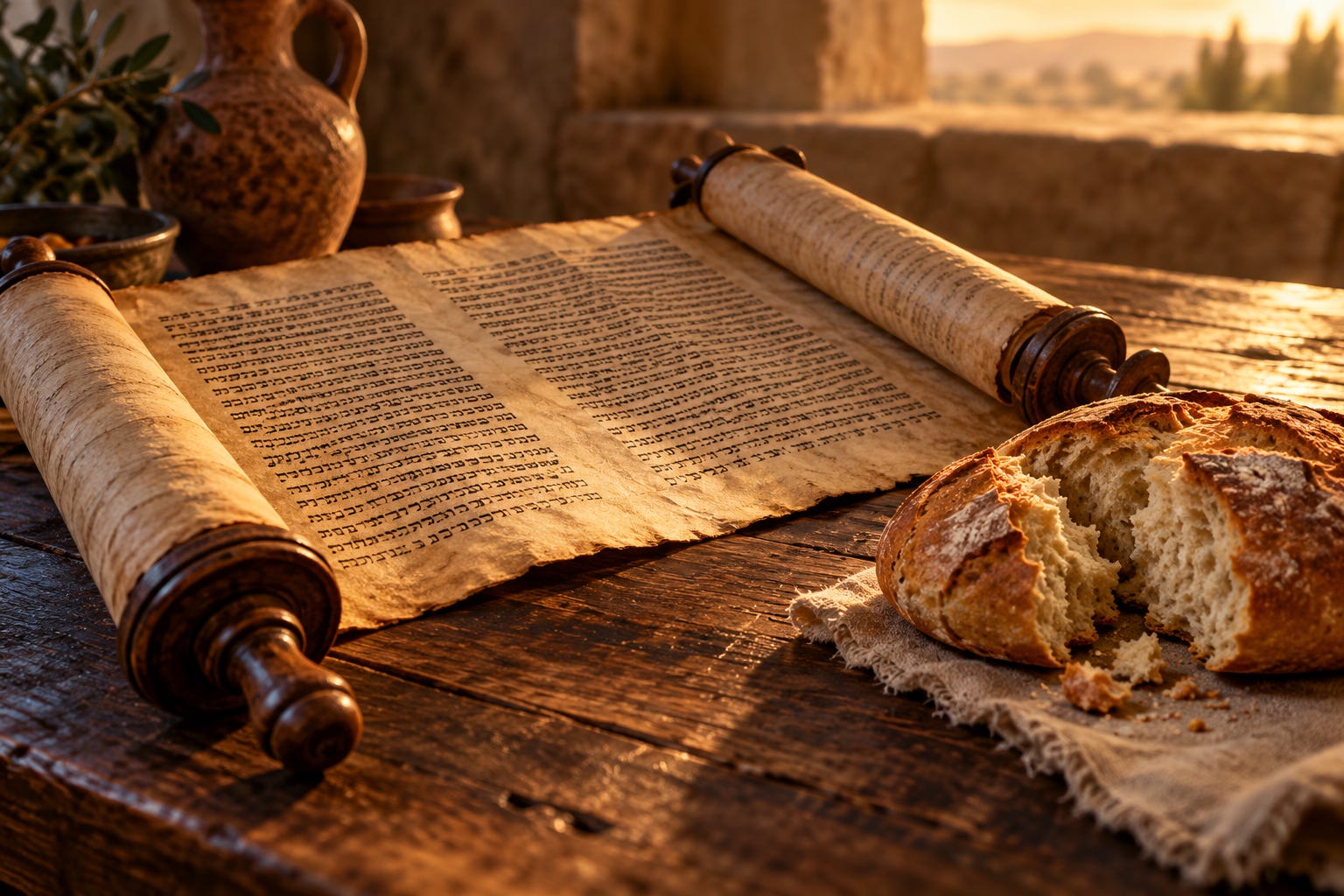
Eat This Book
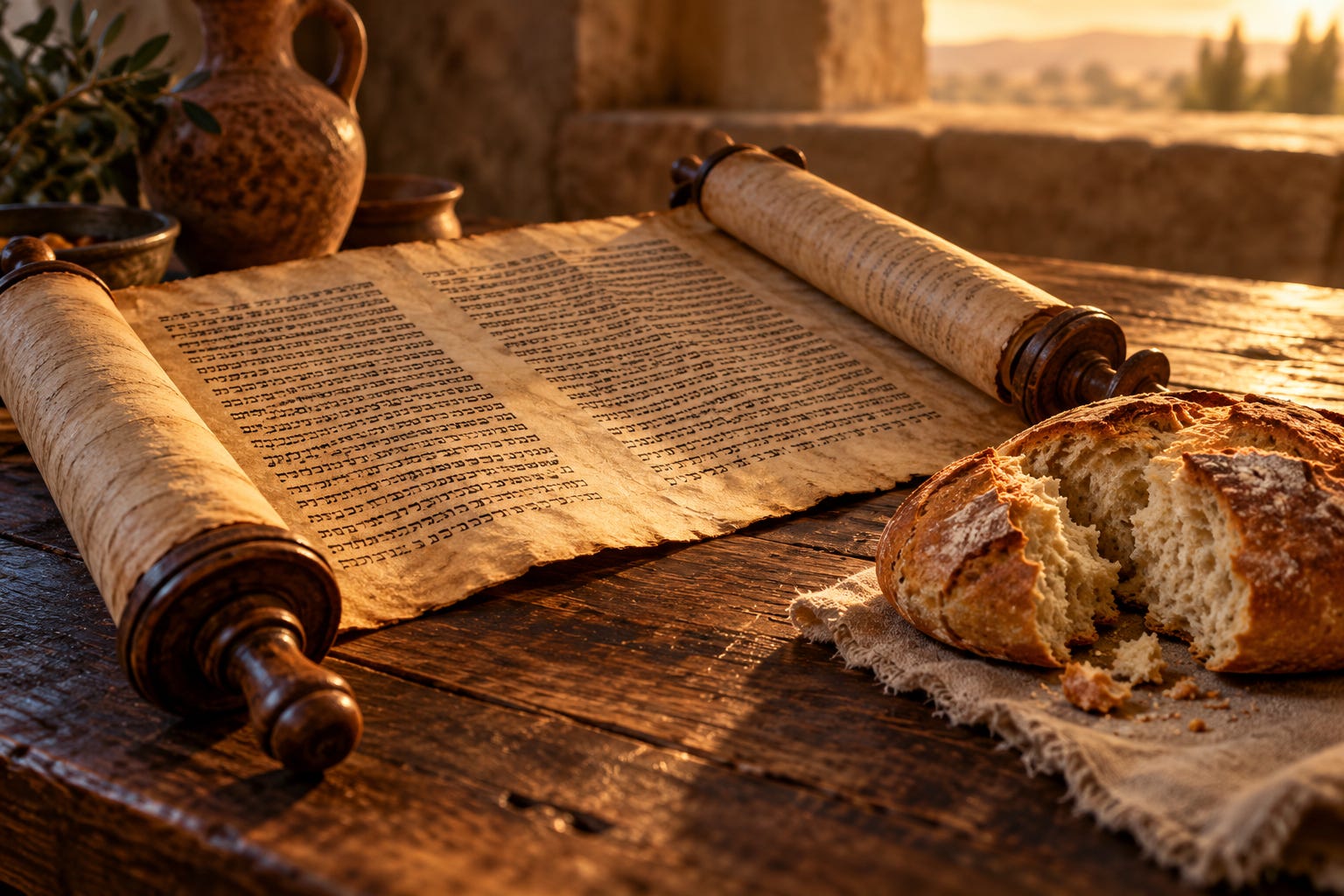
“And I went unto the angel, and said unto him, Give me the little book. And he said unto me, Take it, and eat it.” — Revelation 10:9 (KJV)
We live in an time of unlimited information. We read books, listen to sermons, attend Bible studies, watch teaching videos, and share inspirational Scriptures. We have more access to the Word of God than any generation before us.
But access to the Word and transformation by the Word are vastly different
It is possible to have a head knowledge of Scripture without allowing Scripture to transform us. We can quote verses about forgiveness while holding grudges, teach about generosity while living selfishly, and speak about faith while allowing fear to govern our decisions.
The question is not how much of the Word we have read or heard, but how much of the Word has become part of us.
The Strange Command in Revelation
In Revelation 10, John comes face to face with an angel holding a little book or scroll. A voice from heaven instructs John to take it.
But John is not told only to read the scroll, but to consume it.
Actually, he is told to eat it.
John obeys. The scroll tastes sweet as honey in his mouth, but when he swallows it, his stomach becomes bitter.
Then comes the instruction: he must prophesy again concerning many peoples, nations, tongues, and kings.
John must first consume the message, digest it and then share it. Like anything we consume, it must become part of him. It cannot remain external to who he must become.
The Word must become part of the messenger before it becomes the message he delivers.
This is not the first time that the Bible instructs someone to Eat This Book.
Ezekiel Ate the Word Too
In the Old Testament, God gave the prophet Ezekiel the same instructions.
“Son of man, eat that thou findest; eat this roll, and go speak unto the house of Israel.” — Ezekiel 3:1 (KJV)
Ezekiel was told to eat a scroll containing lamentations, mourning, and woe (Ezekiel 2:10). Yet when he ate it, just like John it was sweet as honey in his mouth.
On thing to note, the contents of the scroll were bitter to the stomach, but receiving God’s Word was sweet.
This is a reminder that the goodness of God’s Word is not determined by how comfortable it makes us feel.
There are times when scripture encourages us and at other times it challenges us.
Sometimes it reassures us of God’s promises. Other times it exposes our pride, challenges our assumptions, or calls us to surrender something we would rather keep.
The Word can be sweet in its truth and bitter in the requirements and consequences of faithfully walking in it.
Just as in the natural, some of the healthiest foods are not always the sweetest.
Reading the Bible or Being Read by It?
Eugene Peterson talks about this concept in his book Eat This Book: A Conversation in the Art of Spiritual Reading.
Peterson challenges the tendency to approach Scripture only as information to be acquired. Instead, he encourages us to receive it as God’s revelation, allowing it to shape the way we live.
We often approach the Bible with questions we want answered. We look for principles that will improve our lives, promises that will reassure us, or passages that support what we already believe.
But what happens when Scripture asks or demands answers from us?
What happens when the Word discerns the thoughts and intents of our hearts and finds us lacking?
Hebrews 4:12 also describes the Word of God as living and powerful, able to separate the soul and spirit.
We may begin by examining the Scriptures, only to discover that the Scriptures are examining us.
We cannot expect to be transformed by a Word we are unwilling to be corrected by.
Digestion Takes Time
Think about what happens when we eat.
Food enters our mouths, but its real benefit comes through digestion. Our bodies break it down, absorb its nutrients, and use them to sustain life.
This is what happens spiritually as well.
Reading introduces us to the Word. Meditation allows us to consider its meaning. Obedience allows that Word to shape our lives.
Jeremiah says it this way:
“Thy words were found, and I did eat them; and thy word was unto me the joy and rejoicing of mine heart.” — Jeremiah 15:16 (KJV)
In his epistle, James the brother of Jesus warns us not to be hearers of the Word only, deceiving ourselves (James 1:22).
The danger is that we may mistake familiarity with Scripture for spiritual maturity.
Knowing what the Bible says about patience does not necessarily make us patient. Understanding biblical generosity does not automatically make us generous. Being able to explain forgiveness does not mean we have forgiven those who have sinned against us.
Transformation occurs as the truth we receive begins to dictate the choices we make.
And that process takes time.
From Consumption to Transformation
We need to reexamine the way we approach scripture.
Instead of asking only, “What did I learn?” we might also ask:
-
What did this passage reveal about God?
-
What did it expose about my own heart?
-
What attitude or behavior needs to change?
-
What would obedience to this passage look like today?
These questions move us from the process of acquiring knowledge toward developing a transformed life.
We should not measure our spiritual growth simply by the number of chapters we have read, sermons we have heard, or Bible studies we have attended.
A more revealing measure may be how the Word is changing the way we respond when life does not go as planned.
Are we becoming more patient? More generous? More forgiving? More content? More obedient?
Is the fruit of the spirit apparent and growing in our lives? Are we abiding in Christ or are we simply acquainted with Him.
These are signs that the Word is moving beyond our minds and taking root in our hearts.
The Word Must Become Flesh in Our Everyday Lives
John 1:14 declares that the Word became flesh and dwelt among us.
In Jesus, truth was lived before it was explained.
As His disciples, we are called to embody His teachings in the ordinary circumstances of life.
The Word we read on Sunday should influence how we speak to our spouses on Monday, how we treat our coworkers on Tuesday, how we manage our finances on Wednesday, and how we respond to disappointment on Thursday.
It should shape our decisions when no one is watching.
Because the goal is not to be people who can recite scripture.
The goal is to become people whose lives increasingly reflect the God revealed in the Bible.
A Closing Reflection
There is something we need to reflect on about John’s experience in Revelation 10.
After eating the scroll, John was told to prophesy again.
The Word he received was not meant to remain within him. It was meant to be expressed through him to the churches of his era and to an even broader audience.
This gives us a clue about God’s intent for His word.
We do not read Scripture simply to accumulate knowledge. We receive it so that our lives can become a testimony to its truth.
So that we can become living epistles, known and read by all men.
Read it. Reflect on it. Wrestle with it. Allow it to challenge you. Then put it into practice.
Don’t just read the Book. Eat it.
Because information was never the goal; transformation was always God’s intention.
Thank you for reading. If this has blessed you consider supporting my work. I have a book coming out on November 16. Click the link below to preorder.
Learn MoreEat This Book
“And I went unto the angel, and said unto him, Give me the little book. And he said unto me, Take it, and eat it.” — Revelation 10:9 (KJV)
We live in an time of unlimited information. We read books, listen to sermons, attend Bible studies, watch teaching videos, and share inspirational Scriptures. We have more access to the Word of God than any generation before us.
But access to the Word and transformation by the Word are vastly different
It is possible to have a head knowledge of Scripture without allowing Scripture to transform us. We can quote verses about forgiveness while holding grudges, teach about generosity while living selfishly, and speak about faith while allowing fear to govern our decisions.
The question is not how much of the Word we have read or heard, but how much of the Word has become part of us.
The Strange Command in Revelation
In Revelation 10, John comes face to face with an angel holding a little book or scroll. A voice from heaven instructs John to take it.
But John is not told only to read the scroll, but to consume it.
Actually, he is told to eat it.
John obeys. The scroll tastes sweet as honey in his mouth, but when he swallows it, his stomach becomes bitter.
Then comes the instruction: he must prophesy again concerning many peoples, nations, tongues, and kings.
John must first consume the message, digest it and then share it. Like anything we consume, it must become part of him. It cannot remain external to who he must become.
The Word must become part of the messenger before it becomes the message he delivers.
This is not the first time that the Bible instructs someone to Eat This Book.
Ezekiel Ate the Word Too
In the Old Testament, God gave the prophet Ezekiel the same instructions.
“Son of man, eat that thou findest; eat this roll, and go speak unto the house of Israel.” — Ezekiel 3:1 (KJV)
Ezekiel was told to eat a scroll containing lamentations, mourning, and woe (Ezekiel 2:10). Yet when he ate it, just like John it was sweet as honey in his mouth.
On thing to note, the contents of the scroll were bitter to the stomach, but receiving God’s Word was sweet.
This is a reminder that the goodness of God’s Word is not determined by how comfortable it makes us feel.
There are times when scripture encourages us and at other times it challenges us.
Sometimes it reassures us of God’s promises. Other times it exposes our pride, challenges our assumptions, or calls us to surrender something we would rather keep.
The Word can be sweet in its truth and bitter in the requirements and consequences of faithfully walking in it.
Just as in the natural, some of the healthiest foods are not always the sweetest.
Reading the Bible or Being Read by It?
Eugene Peterson talks about this concept in his book Eat This Book: A Conversation in the Art of Spiritual Reading.
Peterson challenges the tendency to approach Scripture only as information to be acquired. Instead, he encourages us to receive it as God’s revelation, allowing it to shape the way we live.
We often approach the Bible with questions we want answered. We look for principles that will improve our lives, promises that will reassure us, or passages that support what we already believe.
But what happens when Scripture asks or demands answers from us?
What happens when the Word discerns the thoughts and intents of our hearts and finds us lacking?
Hebrews 4:12 also describes the Word of God as living and powerful, able to separate the soul and spirit.
We may begin by examining the Scriptures, only to discover that the Scriptures are examining us.
We cannot expect to be transformed by a Word we are unwilling to be corrected by.
Digestion Takes Time
Think about what happens when we eat.
Food enters our mouths, but its real benefit comes through digestion. Our bodies break it down, absorb its nutrients, and use them to sustain life.
This is what happens spiritually as well.
Reading introduces us to the Word. Meditation allows us to consider its meaning. Obedience allows that Word to shape our lives.
Jeremiah says it this way:
“Thy words were found, and I did eat them; and thy word was unto me the joy and rejoicing of mine heart.” — Jeremiah 15:16 (KJV)
In his epistle, James the brother of Jesus warns us not to be hearers of the Word only, deceiving ourselves (James 1:22).
The danger is that we may mistake familiarity with Scripture for spiritual maturity.
Knowing what the Bible says about patience does not necessarily make us patient. Understanding biblical generosity does not automatically make us generous. Being able to explain forgiveness does not mean we have forgiven those who have sinned against us.
Transformation occurs as the truth we receive begins to dictate the choices we make.
And that process takes time.
From Consumption to Transformation
We need to reexamine the way we approach scripture.
Instead of asking only, “What did I learn?” we might also ask:
-
What did this passage reveal about God?
-
What did it expose about my own heart?
-
What attitude or behavior needs to change?
-
What would obedience to this passage look like today?
These questions move us from the process of acquiring knowledge toward developing a transformed life.
We should not measure our spiritual growth simply by the number of chapters we have read, sermons we have heard, or Bible studies we have attended.
A more revealing measure may be how the Word is changing the way we respond when life does not go as planned.
Are we becoming more patient? More generous? More forgiving? More content? More obedient?
Is the fruit of the spirit apparent and growing in our lives? Are we abiding in Christ or are we simply acquainted with Him.
These are signs that the Word is moving beyond our minds and taking root in our hearts.
The Word Must Become Flesh in Our Everyday Lives
John 1:14 declares that the Word became flesh and dwelt among us.
In Jesus, truth was lived before it was explained.
As His disciples, we are called to embody His teachings in the ordinary circumstances of life.
The Word we read on Sunday should influence how we speak to our spouses on Monday, how we treat our coworkers on Tuesday, how we manage our finances on Wednesday, and how we respond to disappointment on Thursday.
It should shape our decisions when no one is watching.
Because the goal is not to be people who can recite scripture.
The goal is to become people whose lives increasingly reflect the God revealed in the Bible.
A Closing Reflection
There is something we need to reflect on about John’s experience in Revelation 10.
After eating the scroll, John was told to prophesy again.
The Word he received was not meant to remain within him. It was meant to be expressed through him to the churches of his era and to an even broader audience.
This gives us a clue about God’s intent for His word.
We do not read Scripture simply to accumulate knowledge. We receive it so that our lives can become a testimony to its truth.
So that we can become living epistles, known and read by all men.
Read it. Reflect on it. Wrestle with it. Allow it to challenge you. Then put it into practice.
Don’t just read the Book. Eat it.
Because information was never the goal; transformation was always God’s intention.
Thank you for reading. If this has blessed you consider supporting my work. I have a book coming out on November 16. Click the link below to preorder.
Learn More
A Tent Without a Veil

In the book of Exodus, we see God’s intent to dwell amongst His people.
Exodus 25:8–9:
“And let them make me a sanctuary; that I may dwell among them.”
The Tabernacle of Moses was established according to God’s specific pattern. It communicated both an extraordinary truth and an important limitation: God desired to dwell among His people, but sinful humanity could not casually approach His holiness.
The Tabernacle would show Israel what was necessary for a sinful people to approach a holy God.
The progression looked like this:
Outer Court → Holy Place → Most Holy Place → Ark → Presence of God
The veil separated the Holy Place from the Most Holy Place (Exodus 26:33). The high priest entered the Most Holy Place only according to God’s prescribed conditions, especially on the Day of Atonement (Leviticus 16).
Even though God was in their midst, access was limited. Not everyone could gain access, and even the high priest could only come at a prescribed time.
Something Unusual Happens Under David
After the Ark had been separated from the Mosaic Tabernacle for years, David eventually brought it to Jerusalem.
2 Samuel 6:17:
“And they brought in the ark of the LORD, and set it in his place, in the midst of the tabernacle that David had pitched for it…”
This wasn’t the Tabernacle of Moses. It was a tent David created for the Ark.
Meanwhile, the Mosaic Tabernacle and its altar were at Gibeon (1 Chronicles 16:39–40; 21:29).
Gibeon: Mosaic Tabernacle + bronze altar
Jerusalem: David’s tent + Ark of the Covenant
Israel temporarily had the sanctuary structure in one place and the Ark in another. This is similar to many churches where there is a beautiful structure, but the Spirit is lacking. There is no presence, no moving of the Spirit. Just rituals that appease men but do not please God.
The biblical descriptions of David’s tent do not describe the elaborate sequence of barriers and furnishings associated with Moses’ Tabernacle.
David placed the Ark inside the tent he pitched and appointed Levites to minister before it. The picture of worship being simple and lacking choreographed dances and expensive props should give us an indication of what God is really after.
1 Chronicles 16:4:
“And he appointed certain of the Levites to minister before the ark of the LORD, and to record, and to thank and praise the LORD God of Israel.”
Moses’ Tabernacle represented a specific order and pathway to God.
David’s tent gives us a different picture of worship before the Ark.
David appoints singers and musicians to minister continually before the Ark.
1 Chronicles 16:37:
“So he left there before the ark of the covenant of the LORD Asaph and his brethren, to minister before the ark continually…”
David didn’t invent worship, but he organized continual worship around the presence of God.
The emphasis is no longer merely bringing a sacrifice but includes singing, praising, and worshiping with our mouths as instruments.
Then Amos Says Something Unexpected
Hundreds of years later, Amos prophesies:
Amos 9:11:
“In that day will I raise up the tabernacle of David that is fallen…”
Why David’s tabernacle?
Why doesn’t Amos say, “I will restore the Tabernacle of Moses”?
Acts 15 Gives Us the New Testament Connection
The early Church is wrestling with a major question:
Must Gentiles essentially become Jews in order to belong to God’s covenant people?
Peter, Paul, Barnabas, James, and the Jerusalem assembly are dealing with Gentile inclusion.
Then James quotes Amos 9:11–12.
Acts 15:16–17:
“After this I will return, and will build again the tabernacle of David, which is fallen down… That the residue of men might seek after the Lord, and all the Gentiles, upon whom my name is called…”
The New Testament explicitly connects the restoration of David’s fallen tent with God’s work among the Gentiles.
God is forming a people for His name from among the nations, and these individuals will be able to access His presence continually.
Matthew 27:50–51:
“Jesus, when he had cried again with a loud voice, yielded up the ghost. And, behold, the veil of the temple was rent in twain from the top to the bottom…”
Hebrews 10:19–22: Believers now have boldness to enter the holiest by the blood of Jesus.
God’s ultimate objective was never merely a better religious building.
He was creating a people. His Ekklesia.
Acts 15 isn’t celebrating the construction of another tent in Jerusalem. James sees Amos’s prophecy being fulfilled as God takes from the Gentiles “a people for his name” (Acts 15:14).
The restoration of David’s Tabernacle isn’t ultimately about rebuilding David’s tent. It is about God gathering a people around His presence, including people who once stood outside the covenant community.
Jews and Gentiles are no longer strangers from one another but are being “builded together for an habitation of God through the Spirit” (Ephesians 2:19–22).
The question we should then be asking is: How often do I take advantage of being able to come freely into His presence?
God removed the veil so we could have access. Let us come boldly, as often as possible, to sit at His feet and worship in His presence.
Learn MoreA Tent Without a Veil
In the book of Exodus, we see God’s intent to dwell amongst His people.
Exodus 25:8–9:
“And let them make me a sanctuary; that I may dwell among them.”
The Tabernacle of Moses was established according to God’s specific pattern. It communicated both an extraordinary truth and an important limitation: God desired to dwell among His people, but sinful humanity could not casually approach His holiness.
The Tabernacle would show Israel what was necessary for a sinful people to approach a holy God.
The progression looked like this:
Outer Court → Holy Place → Most Holy Place → Ark → Presence of God
The veil separated the Holy Place from the Most Holy Place (Exodus 26:33). The high priest entered the Most Holy Place only according to God’s prescribed conditions, especially on the Day of Atonement (Leviticus 16).
Even though God was in their midst, access was limited. Not everyone could gain access, and even the high priest could only come at a prescribed time.
Something Unusual Happens Under David
After the Ark had been separated from the Mosaic Tabernacle for years, David eventually brought it to Jerusalem.
2 Samuel 6:17:
“And they brought in the ark of the LORD, and set it in his place, in the midst of the tabernacle that David had pitched for it…”
This wasn’t the Tabernacle of Moses. It was a tent David created for the Ark.
Meanwhile, the Mosaic Tabernacle and its altar were at Gibeon (1 Chronicles 16:39–40; 21:29).
Gibeon: Mosaic Tabernacle + bronze altar
Jerusalem: David’s tent + Ark of the Covenant
Israel temporarily had the sanctuary structure in one place and the Ark in another. This is similar to many churches where there is a beautiful structure, but the Spirit is lacking. There is no presence, no moving of the Spirit. Just rituals that appease men but do not please God.
The biblical descriptions of David’s tent do not describe the elaborate sequence of barriers and furnishings associated with Moses’ Tabernacle.
David placed the Ark inside the tent he pitched and appointed Levites to minister before it. The picture of worship being simple and lacking choreographed dances and expensive props should give us an indication of what God is really after.
1 Chronicles 16:4:
“And he appointed certain of the Levites to minister before the ark of the LORD, and to record, and to thank and praise the LORD God of Israel.”
Moses’ Tabernacle represented a specific order and pathway to God.
David’s tent gives us a different picture of worship before the Ark.
David appoints singers and musicians to minister continually before the Ark.
1 Chronicles 16:37:
“So he left there before the ark of the covenant of the LORD Asaph and his brethren, to minister before the ark continually…”
David didn’t invent worship, but he organized continual worship around the presence of God.
The emphasis is no longer merely bringing a sacrifice but includes singing, praising, and worshiping with our mouths as instruments.
Then Amos Says Something Unexpected
Hundreds of years later, Amos prophesies:
Amos 9:11:
“In that day will I raise up the tabernacle of David that is fallen…”
Why David’s tabernacle?
Why doesn’t Amos say, “I will restore the Tabernacle of Moses”?
Acts 15 Gives Us the New Testament Connection
The early Church is wrestling with a major question:
Must Gentiles essentially become Jews in order to belong to God’s covenant people?
Peter, Paul, Barnabas, James, and the Jerusalem assembly are dealing with Gentile inclusion.
Then James quotes Amos 9:11–12.
Acts 15:16–17:
“After this I will return, and will build again the tabernacle of David, which is fallen down… That the residue of men might seek after the Lord, and all the Gentiles, upon whom my name is called…”
The New Testament explicitly connects the restoration of David’s fallen tent with God’s work among the Gentiles.
God is forming a people for His name from among the nations, and these individuals will be able to access His presence continually.
Matthew 27:50–51:
“Jesus, when he had cried again with a loud voice, yielded up the ghost. And, behold, the veil of the temple was rent in twain from the top to the bottom…”
Hebrews 10:19–22: Believers now have boldness to enter the holiest by the blood of Jesus.
God’s ultimate objective was never merely a better religious building.
He was creating a people. His Ekklesia.
Acts 15 isn’t celebrating the construction of another tent in Jerusalem. James sees Amos’s prophecy being fulfilled as God takes from the Gentiles “a people for his name” (Acts 15:14).
The restoration of David’s Tabernacle isn’t ultimately about rebuilding David’s tent. It is about God gathering a people around His presence, including people who once stood outside the covenant community.
Jews and Gentiles are no longer strangers from one another but are being “builded together for an habitation of God through the Spirit” (Ephesians 2:19–22).
The question we should then be asking is: How often do I take advantage of being able to come freely into His presence?
God removed the veil so we could have access. Let us come boldly, as often as possible, to sit at His feet and worship in His presence.
Learn More
There Is More to the Cross
Jesus’ high priestly prayer in John 17 gives us insight into His heart and His desire, not only for His disciples, but for those who would come after them.
“Sanctify them through thy truth: thy word is truth.”
— John 17:17
The Cross did not merely accomplish forgiveness from sin. Christ’s death was redemptive, but redemption was accomplishing something. Christ was purchasing and preparing a people for Himself, a Bride who would reflect Him and carry out His purpose.
There is more to the Cross than getting you out of hell.
The Cross was not only about what Christ was delivering you from. It was also about what Christ was bringing you into.
From His Side
In Genesis 2, God caused Adam to sleep, opened his side, and from his side formed his bride.
Paul later tells us there was something much larger being revealed in that first marriage:
“This is a great mystery: but I speak concerning Christ and the church.”
— Ephesians 5:32
The first marriage points beyond Adam and Eve to Christ and His Church.
That makes what happens at Calvary striking.
Christ enters the sleep of death, His side is pierced, and blood and water flow.
There is a striking biblical picture here.
From the side of the first Adam came his bride. From the pierced side of the Last Adam came blood and water, and throughout Scripture we see what Christ is accomplishing in His Bride.
The Blood Purchases the Bride
Paul tells the Ephesian elders that Christ purchased the Church “with his own blood” (Acts 20:28).
The blood does not merely forgive individuals.
The blood purchases a people.
Christ is not merely rescuing disconnected sinners. He is creating a redeemed community that belongs to Him.
This is the Ekklesia, a people called by God into community and centered in Christ.
The Word Prepares the Bride
Ephesians takes us further:
“Christ also loved the church, and gave himself for it; that he might sanctify and cleanse it with the washing of water by the word.”
— Ephesians 5:25–26
Notice the progression.
He loved her.
He gave Himself for her.
He sanctifies her.
He cleanses her.
Why?
“That he might present it to himself a glorious church, not having spot, or wrinkle, or any such thing.”
— Ephesians 5:27
The blood purchases the Bride. The Word prepares the Bride.
The blood deals with my guilt. The Word confronts my patterns, my habits, my thinking, and my desires.
You Have to Wash
The bronze laver in the Old Testament gives us another picture.
A priest could not stand at a distance from the laver and become clean. He could not admire the laver. He could not listen to someone lecture about the laver.
He had to wash.
Likewise, it isn’t enough to own a Bible. It isn’t enough to attend a church where the Bible is preached. It isn’t even enough to know Scripture.
The question is:
Have I allowed the Word to deal with me?
James tells us to be doers of the Word and not hearers only, deceiving ourselves.
The washing of the Word is more than hearing a sermon on Sunday. It is sitting with Scripture, meditating on it, wrestling with it, and allowing it to wash over the hidden places of the heart until our thinking, desires, habits, and decisions are brought under the authority of Christ.
You are not washed by the Word simply because you heard it. You are washed by the Word when you remain under it long enough for it to change you.
There Is More to the Cross
The blood changes our standing.
The Word changes our condition.
The blood gives us access.
The Word prepares us to live in the presence we have been given access to.
The blood purchased the Bride.
The Word prepares the Bride.
And the priest did not wash once and assume he was ready forever. He returned to the laver.
So must we.
We continually return to the Word, not merely for information, but for cleansing, correction, and formation.
Jesus did not die merely so that forgiven people could wait for heaven.
He was purchasing a people.
He was preparing a Bride.
He was creating an Ekklesia.
He was restoring access to the presence of God.
And He was forming a people through whom His life, character, wisdom, and Kingdom could be made visible.
There is more to the Cross than what Jesus brought you out of.
The question is: What is the Cross bringing you into, and are you allowing the Word to prepare you for it?
Learn MoreThere Is More to the Cross
Jesus’ high priestly prayer in John 17 gives us insight into His heart and His desire, not only for His disciples, but for those who would come after them.
“Sanctify them through thy truth: thy word is truth.”
— John 17:17
The Cross did not merely accomplish forgiveness from sin. Christ’s death was redemptive, but redemption was accomplishing something. Christ was purchasing and preparing a people for Himself, a Bride who would reflect Him and carry out His purpose.
There is more to the Cross than getting you out of hell.
The Cross was not only about what Christ was delivering you from. It was also about what Christ was bringing you into.
From His Side
In Genesis 2, God caused Adam to sleep, opened his side, and from his side formed his bride.
Paul later tells us there was something much larger being revealed in that first marriage:
“This is a great mystery: but I speak concerning Christ and the church.”
— Ephesians 5:32
The first marriage points beyond Adam and Eve to Christ and His Church.
That makes what happens at Calvary striking.
Christ enters the sleep of death, His side is pierced, and blood and water flow.
There is a striking biblical picture here.
From the side of the first Adam came his bride. From the pierced side of the Last Adam came blood and water, and throughout Scripture we see what Christ is accomplishing in His Bride.
The Blood Purchases the Bride
Paul tells the Ephesian elders that Christ purchased the Church “with his own blood” (Acts 20:28).
The blood does not merely forgive individuals.
The blood purchases a people.
Christ is not merely rescuing disconnected sinners. He is creating a redeemed community that belongs to Him.
This is the Ekklesia, a people called by God into community and centered in Christ.
The Word Prepares the Bride
Ephesians takes us further:
“Christ also loved the church, and gave himself for it; that he might sanctify and cleanse it with the washing of water by the word.”
— Ephesians 5:25–26
Notice the progression.
He loved her.
He gave Himself for her.
He sanctifies her.
He cleanses her.
Why?
“That he might present it to himself a glorious church, not having spot, or wrinkle, or any such thing.”
— Ephesians 5:27
The blood purchases the Bride. The Word prepares the Bride.
The blood deals with my guilt. The Word confronts my patterns, my habits, my thinking, and my desires.
You Have to Wash
The bronze laver in the Old Testament gives us another picture.
A priest could not stand at a distance from the laver and become clean. He could not admire the laver. He could not listen to someone lecture about the laver.
He had to wash.
Likewise, it isn’t enough to own a Bible. It isn’t enough to attend a church where the Bible is preached. It isn’t even enough to know Scripture.
The question is:
Have I allowed the Word to deal with me?
James tells us to be doers of the Word and not hearers only, deceiving ourselves.
The washing of the Word is more than hearing a sermon on Sunday. It is sitting with Scripture, meditating on it, wrestling with it, and allowing it to wash over the hidden places of the heart until our thinking, desires, habits, and decisions are brought under the authority of Christ.
You are not washed by the Word simply because you heard it. You are washed by the Word when you remain under it long enough for it to change you.
There Is More to the Cross
The blood changes our standing.
The Word changes our condition.
The blood gives us access.
The Word prepares us to live in the presence we have been given access to.
The blood purchased the Bride.
The Word prepares the Bride.
And the priest did not wash once and assume he was ready forever. He returned to the laver.
So must we.
We continually return to the Word, not merely for information, but for cleansing, correction, and formation.
Jesus did not die merely so that forgiven people could wait for heaven.
He was purchasing a people.
He was preparing a Bride.
He was creating an Ekklesia.
He was restoring access to the presence of God.
And He was forming a people through whom His life, character, wisdom, and Kingdom could be made visible.
There is more to the Cross than what Jesus brought you out of.
The question is: What is the Cross bringing you into, and are you allowing the Word to prepare you for it?
Learn More