
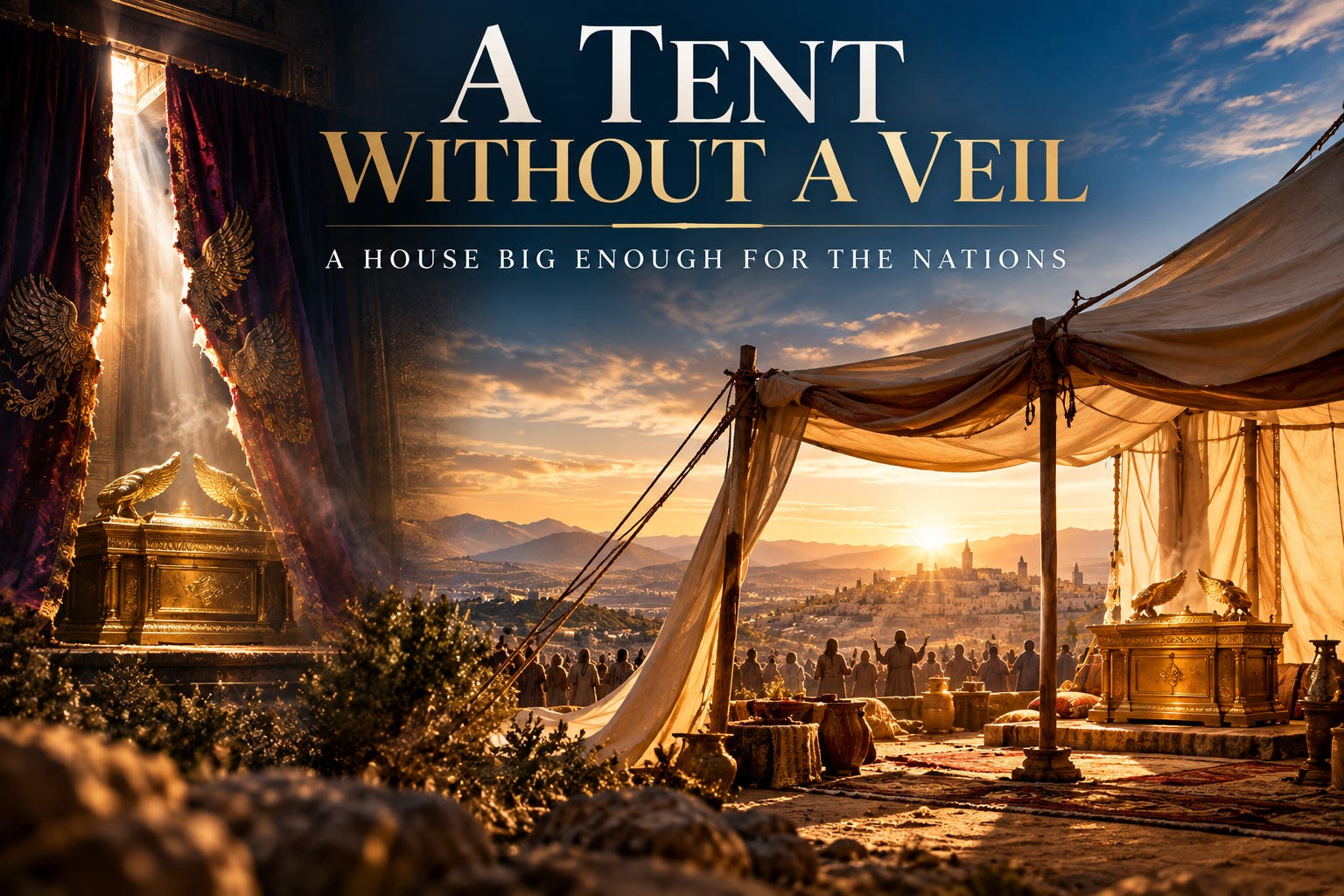
A Tent Without a Veil
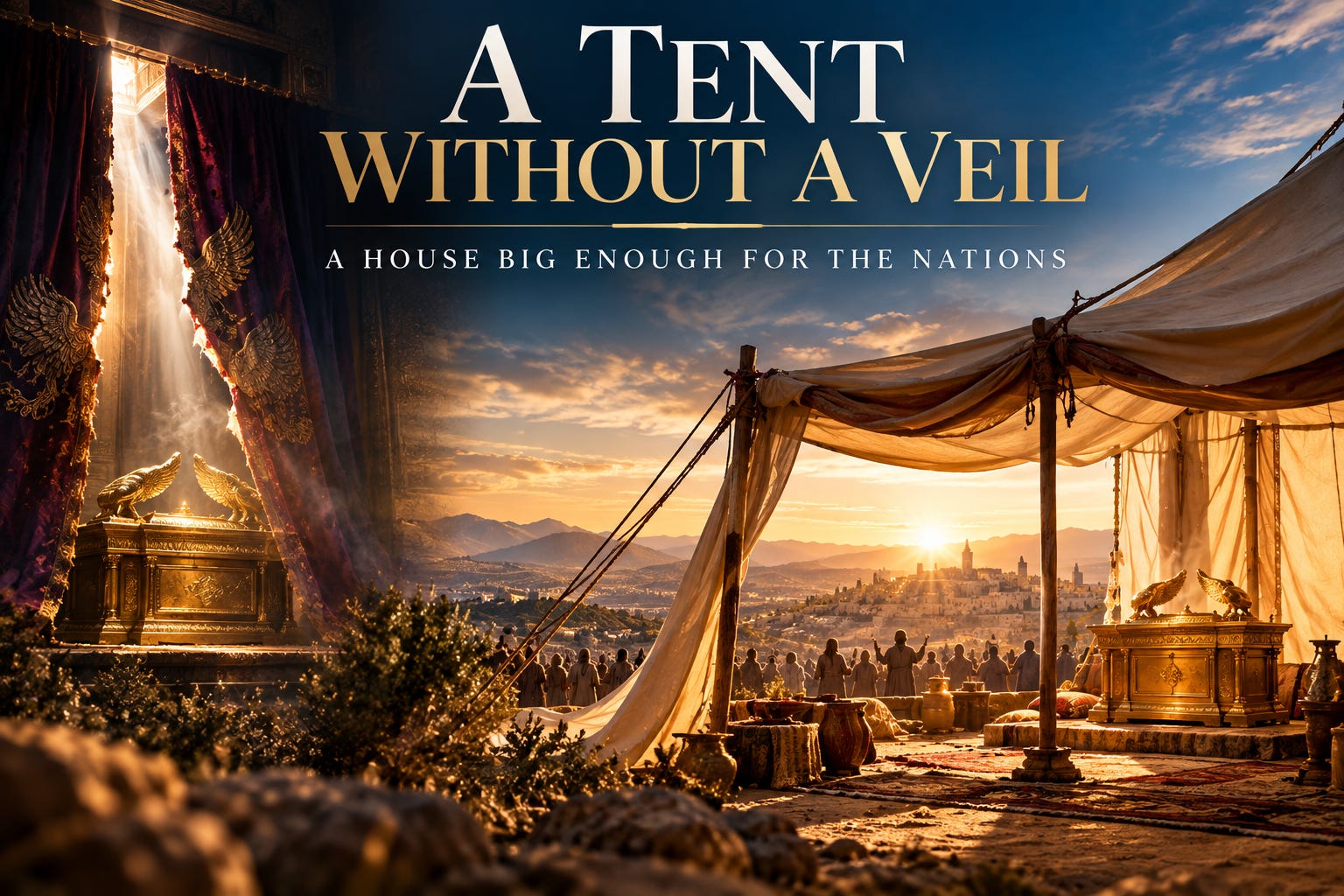
In the book of Exodus, we see God’s intent to dwell amongst His people.
Exodus 25:8–9:
“And let them make me a sanctuary; that I may dwell among them.”
The Tabernacle of Moses was established according to God’s specific pattern. It communicated both an extraordinary truth and an important limitation: God desired to dwell among His people, but sinful humanity could not casually approach His holiness.
The Tabernacle would show Israel what was necessary for a sinful people to approach a holy God.
The progression looked like this:
Outer Court → Holy Place → Most Holy Place → Ark → Presence of God
The veil separated the Holy Place from the Most Holy Place (Exodus 26:33). The high priest entered the Most Holy Place only according to God’s prescribed conditions, especially on the Day of Atonement (Leviticus 16).
Even though God was in their midst, access was limited. Not everyone could gain access, and even the high priest could only come at a prescribed time.
Something Unusual Happens Under David
After the Ark had been separated from the Mosaic Tabernacle for years, David eventually brought it to Jerusalem.
2 Samuel 6:17:
“And they brought in the ark of the LORD, and set it in his place, in the midst of the tabernacle that David had pitched for it…”
This wasn’t the Tabernacle of Moses. It was a tent David created for the Ark.
Meanwhile, the Mosaic Tabernacle and its altar were at Gibeon (1 Chronicles 16:39–40; 21:29).
Gibeon: Mosaic Tabernacle + bronze altar
Jerusalem: David’s tent + Ark of the Covenant
Israel temporarily had the sanctuary structure in one place and the Ark in another. This is similar to many churches where there is a beautiful structure, but the Spirit is lacking. There is no presence, no moving of the Spirit. Just rituals that appease men but do not please God.
The biblical descriptions of David’s tent do not describe the elaborate sequence of barriers and furnishings associated with Moses’ Tabernacle.
David placed the Ark inside the tent he pitched and appointed Levites to minister before it. The picture of worship being simple and lacking choreographed dances and expensive props should give us an indication of what God is really after.
1 Chronicles 16:4:
“And he appointed certain of the Levites to minister before the ark of the LORD, and to record, and to thank and praise the LORD God of Israel.”
Moses’ Tabernacle represented a specific order and pathway to God.
David’s tent gives us a different picture of worship before the Ark.
David appoints singers and musicians to minister continually before the Ark.
1 Chronicles 16:37:
“So he left there before the ark of the covenant of the LORD Asaph and his brethren, to minister before the ark continually…”
David didn’t invent worship, but he organized continual worship around the presence of God.
The emphasis is no longer merely bringing a sacrifice but includes singing, praising, and worshiping with our mouths as instruments.
Then Amos Says Something Unexpected
Hundreds of years later, Amos prophesies:
Amos 9:11:
“In that day will I raise up the tabernacle of David that is fallen…”
Why David’s tabernacle?
Why doesn’t Amos say, “I will restore the Tabernacle of Moses”?
Acts 15 Gives Us the New Testament Connection
The early Church is wrestling with a major question:
Must Gentiles essentially become Jews in order to belong to God’s covenant people?
Peter, Paul, Barnabas, James, and the Jerusalem assembly are dealing with Gentile inclusion.
Then James quotes Amos 9:11–12.
Acts 15:16–17:
“After this I will return, and will build again the tabernacle of David, which is fallen down… That the residue of men might seek after the Lord, and all the Gentiles, upon whom my name is called…”
The New Testament explicitly connects the restoration of David’s fallen tent with God’s work among the Gentiles.
God is forming a people for His name from among the nations, and these individuals will be able to access His presence continually.
Matthew 27:50–51:
“Jesus, when he had cried again with a loud voice, yielded up the ghost. And, behold, the veil of the temple was rent in twain from the top to the bottom…”
Hebrews 10:19–22: Believers now have boldness to enter the holiest by the blood of Jesus.
God’s ultimate objective was never merely a better religious building.
He was creating a people. His Ekklesia.
Acts 15 isn’t celebrating the construction of another tent in Jerusalem. James sees Amos’s prophecy being fulfilled as God takes from the Gentiles “a people for his name” (Acts 15:14).
The restoration of David’s Tabernacle isn’t ultimately about rebuilding David’s tent. It is about God gathering a people around His presence, including people who once stood outside the covenant community.
Jews and Gentiles are no longer strangers from one another but are being “builded together for an habitation of God through the Spirit” (Ephesians 2:19–22).
The question we should then be asking is: How often do I take advantage of being able to come freely into His presence?
God removed the veil so we could have access. Let us come boldly, as often as possible, to sit at His feet and worship in His presence.